
Apr/May 2023
FRANCES SIMONS
Photographs Tony Sheffield
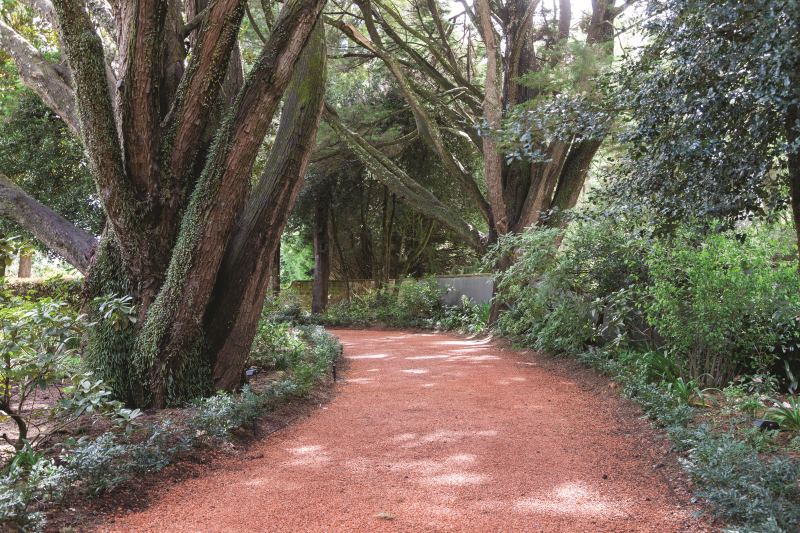
UNDER A SHELTERING CANOPY of aged pines and woodland trees, past fern-covered trunks, shrubby evergreens and moss-topped walls, the driveway into Thenford Lodge keeps views close within its gravelled arc. It’s a road to be taken slowly, a transition from one world to another, where forest magic takes hold. One slows and lingers, even as the path beckons forwards.
There are many such soft enchantments within the 15 acres (6ha) of garden hidden behind this wooded entrance to the Exeter home of former politician John Sharp AM and partner Rosemary Cummins. There are also bold flourishes, elegant classically inspired symmetry, restful hedges and vibrant colours, together with a fair measure of humour and surprise.
The gardens have been a work in progress on a grand scale since John bought the property in 2017 (the luxury estate was then called Rona Lodge). A farmer, businessman and rotary-wing and fixed-wing aircraft pilot, John became a National Party member of Federal parliament in 1984, representing the then new ‘Cowra to Nowra’ seat of Gilmore until 1993, when he was elected as Member for Hume after the seat’s boundary change. In 1996 he became Minister for Transport and Regional Development.
Since retiring from Federal parliament in 1998, John has held a range of directorships and executive and advisory roles across industry sectors including aviation (he is deputy chair of Rex Airlines), aerospace, ship building, engineering, equestrian sports, education and the arts. But it’s clear that John’s early agricultural background remains his strongest anchor.
“I always think of myself as a farmer first,” John says, “deeply committed to the development of regional businesses and rural economies. Right now I’m involved in establishing a facility [at neighbouring Thenford Farm] to service and grow the local equine industry, which I see as a good fit for this area. We’ve got the space, the climate and easy access to Sydney. Horses and all the things associated with their care, training and management are big generators of employment and income, and help maintain the Highlands’ rural atmosphere.”
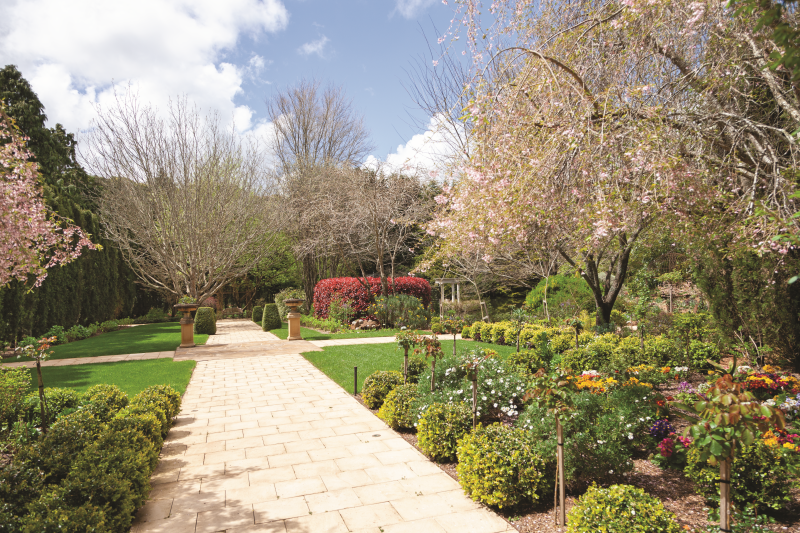
With occasional homage to this and other aspects of his diverse interests, influences and passions, Thenford’s gardens have already achieved results of great stature and beauty.
Towards the house, the driveway emerges from its woodland glen to find clear air and a wide expanse of lawn.
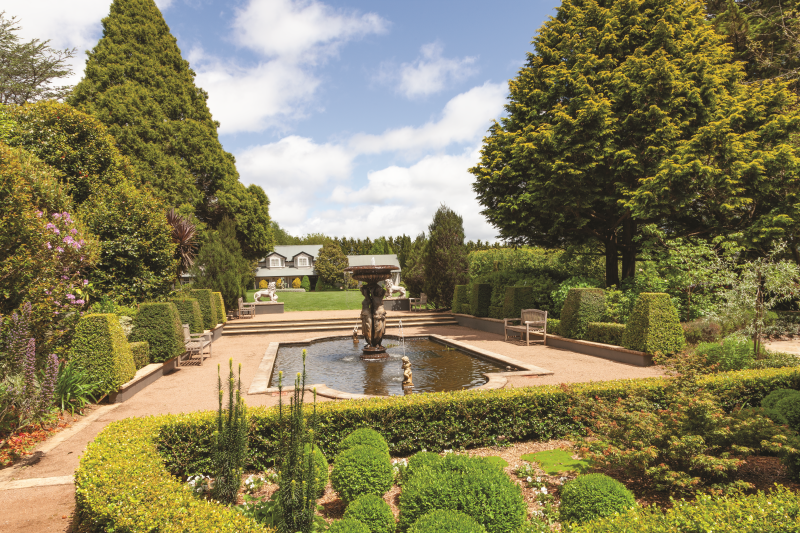
A cherubic fountain stands between house and lawn, with a clipped teucrium hedge encircling its base, neatly defining its smooth form against the angular stonework on which it sits. Evergreen magnolias either side of the main door and mixed conifers behind box hedges soften the house facade.
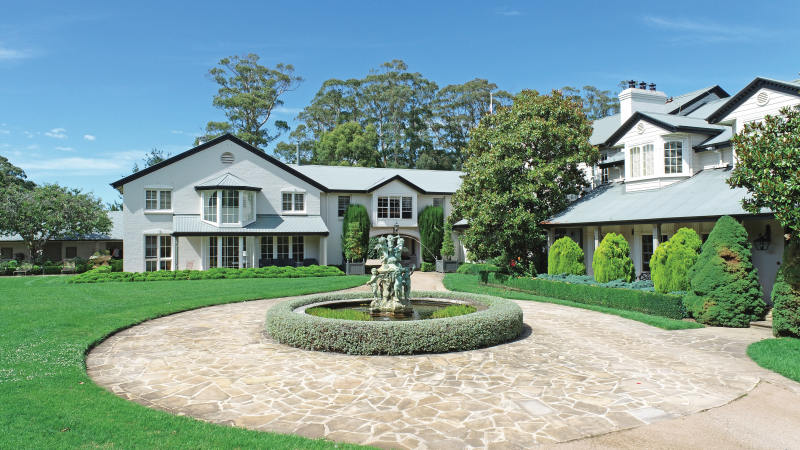
It’s an unexpected arrival from a closely secluded entrance, and one that sets the scene for scale and wonder.
“What we’ve done with the garden is to build and improve on what was here, adding many new elements along the way,” says John.
“Developing these gardens has been very satisfying. On one level, we enjoy them immensely, but there’s also huge satisfaction in creating something that I hope will in some way leave a positive mark.”
Stone flagging leads around the north-east wing of the house, bordered by triple-tiered ripples of low wave-pruned buxus.
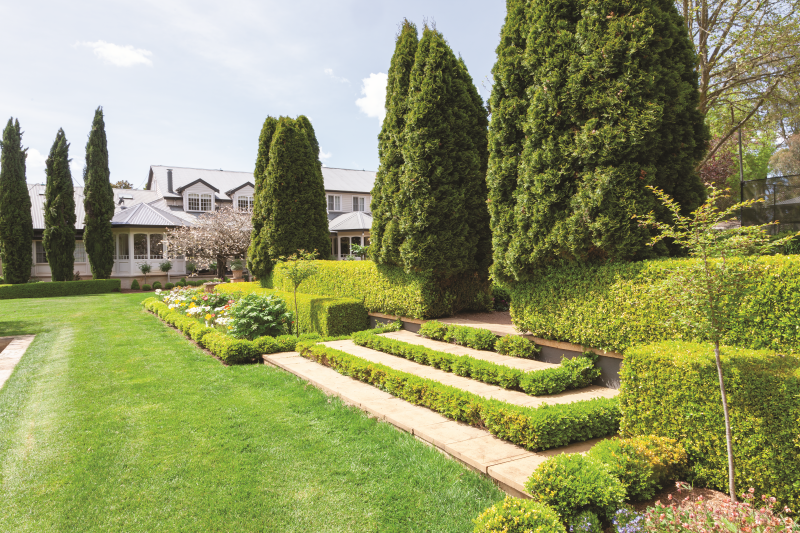
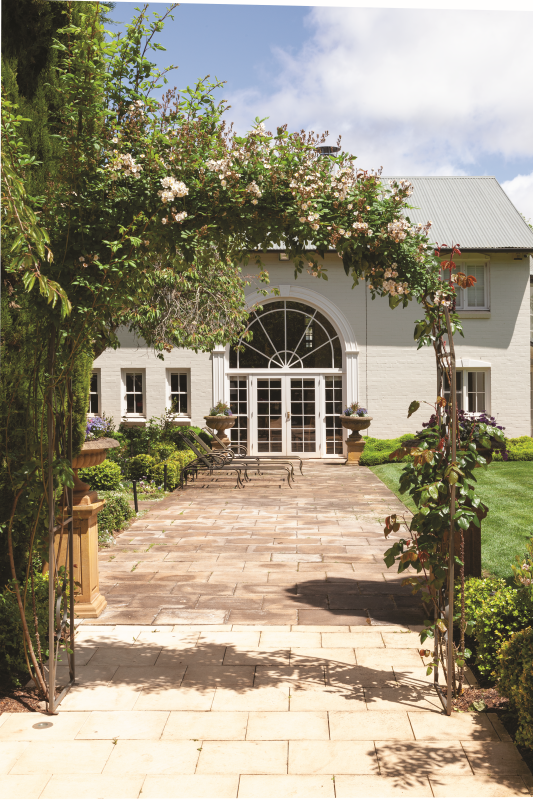
Passing alongside the old stables there’s an ornamental cherry, and border beds of camellias, roses and annuals. The promenade continues between wide urns on stone plinths, spilling pops of blue lobelia, pink petunia and magenta dianthus, and on through a rose-covered arch and into a lawned area enclosed by upright conifers, a mid-height photinia screen and long runs of white ‘Annabelle’ hydrangeas (H. arborescens), a splendid feature also found in other parts of the gardens.
Buxus hedges, balls and taller clipped shapes standing sentry-like either side of the promenade provide formal structure to the area, which is nonetheless relaxed and inviting due to plantings of freely flowering plants including lilies, roses and daisies, and the fine leaves and spread of a golden ash.
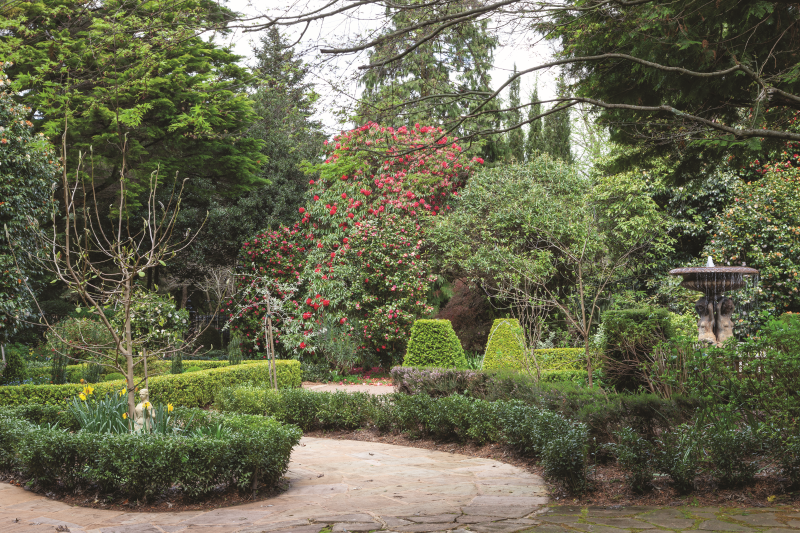
This green anteroom marks the entrance to an extensive garden area, largely shaded by tall deciduous trees and deodar conifers, where woodlands, a lake, winding paths, temples, sculptures and fountains create an atmosphere of languid tranquillity.
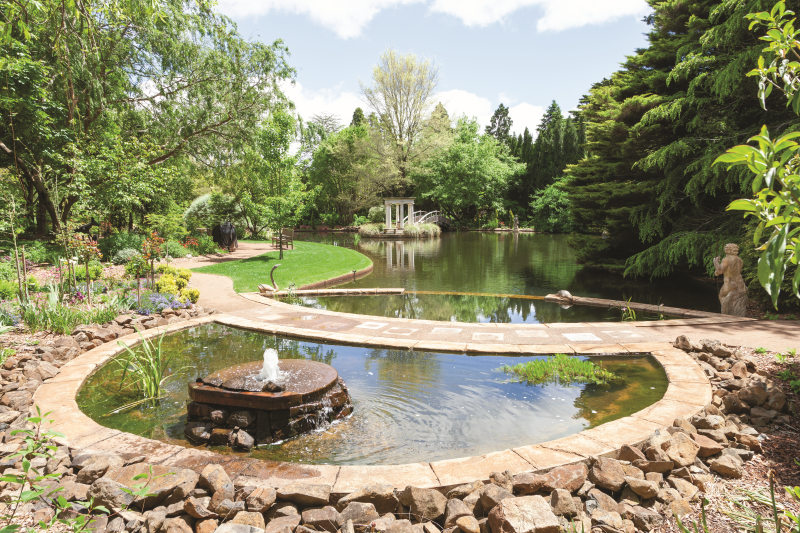
Glimpses of the lake’s arched bridge and island with stone temple are enticing from various points in the woodland, and closer to its edge there’s seating and a view opposite of a second temple, built from wood. Called the Alexander Temple, it is named after Alexander the Great, much admired as an historic figure by John; Alexander is also the name of his eldest son. Poseidon presides over the scene, and two variegated elms frame views of bridge and temple, their luminescent silver-streaked leaves lighting up the shadier end of the water.
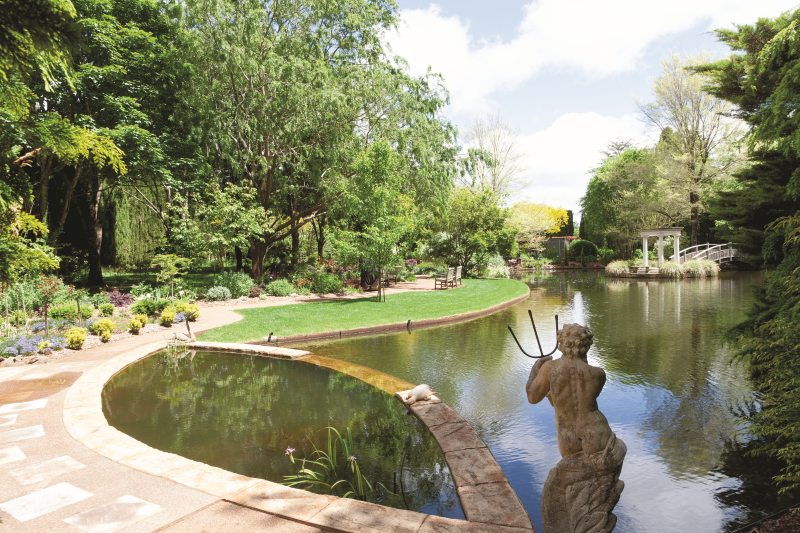
“We created the lake from what was a bit of a rough dam,” says John. “We dealt with drainage and put in a recirculating pump station. We built up and edged the island, added a bridge then a stone temple, which was the beautiful setting where my daughter Emily and her husband signed their marriage certificate just 18 months ago.”
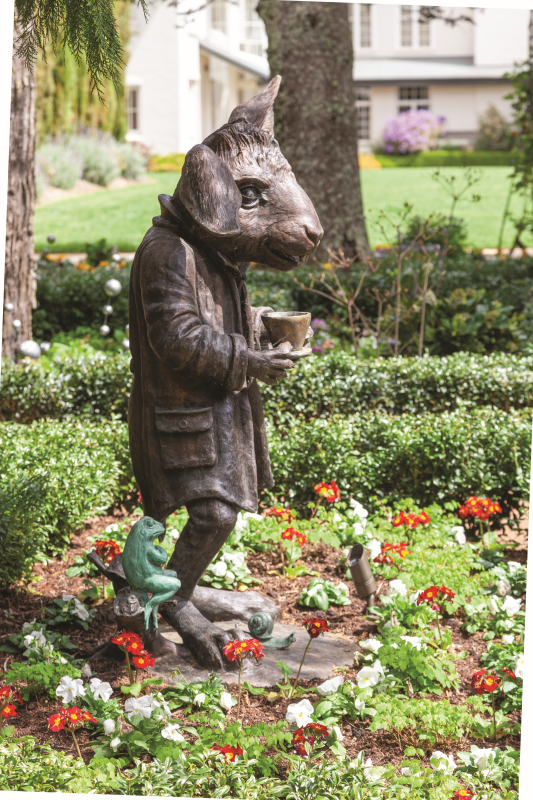
On the western side of the lake is another wooded area, more formally arranged. Demonstrating the general shadiness of the grove, the straight-angled maze-like path is bordered by lush sweetbox (Sarcococca ruscifolia), turning this way and that to meet two larger-than-life bronze figures, straight from Alice in Wonderland. A perfect place for a tea party indeed, overlooked by an apt sculpture of a short-trousered boy holding a model plane, no doubt dreaming.
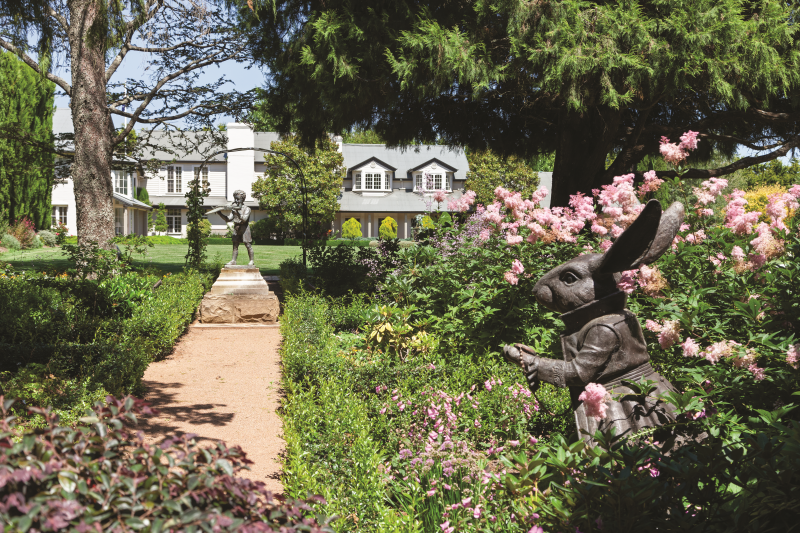
Wonderland continues on to the sunken lion-guarded garden of The Three Graces, who stand in the centre of an oblong pool, with water droplets falling as a veil around their nubile bodies.
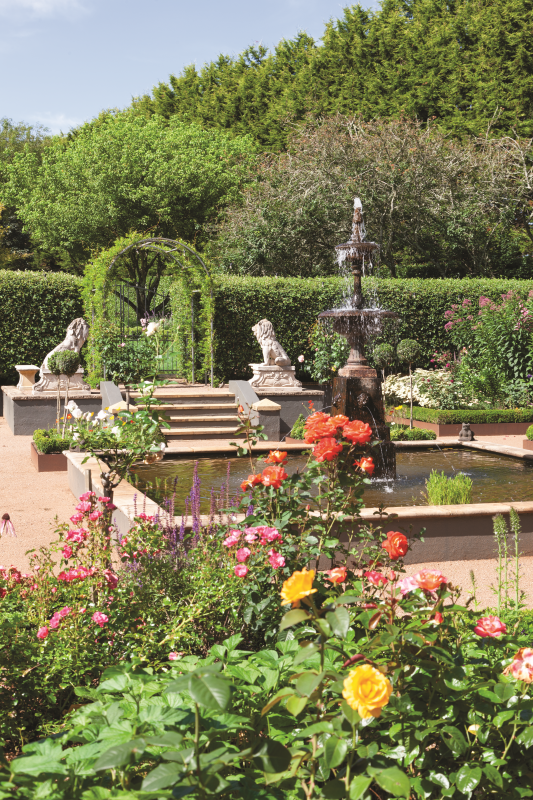
Camellias and formally clipped buxus define the area, along with magnolia, olive and cordyline. It’s a beautifully eclectic mix of plants, reflecting both history and future planning.
In terms of plant selection, John leaves much of the decision making to his team of six gardeners, who have wide scope to choose what will work against his broad brief for colour.
“My contribution to what gets planted is largely ‘Just bring me colour’ or ‘Plant things that generate colour’, because that’s something I love,” says John. “In all matters to do with trees and plants, I’ve learnt to take advice from people who know.
“We had five arborists working for three weeks when we first got here, dealing with a whole lot of tree problems. I thought the approach they recommended was going to kill the trees rather than help them, but they went ahead anyway. They were right and, out of ignorance, I was wrong.”
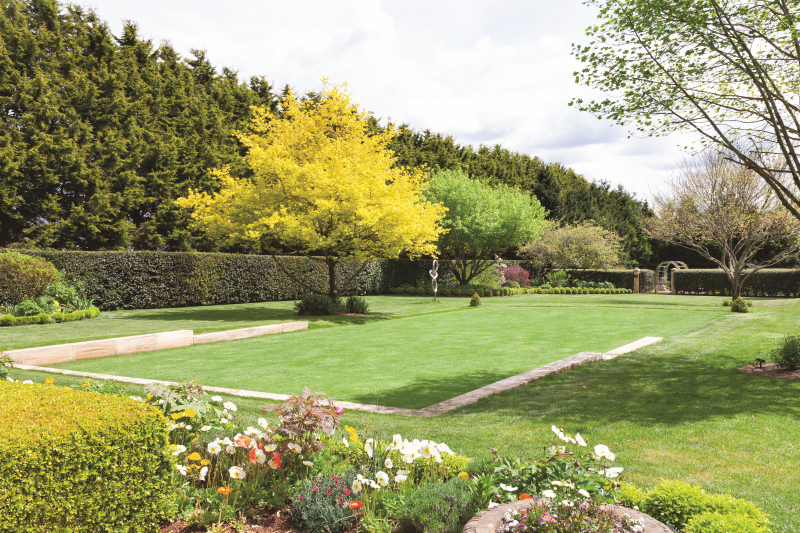
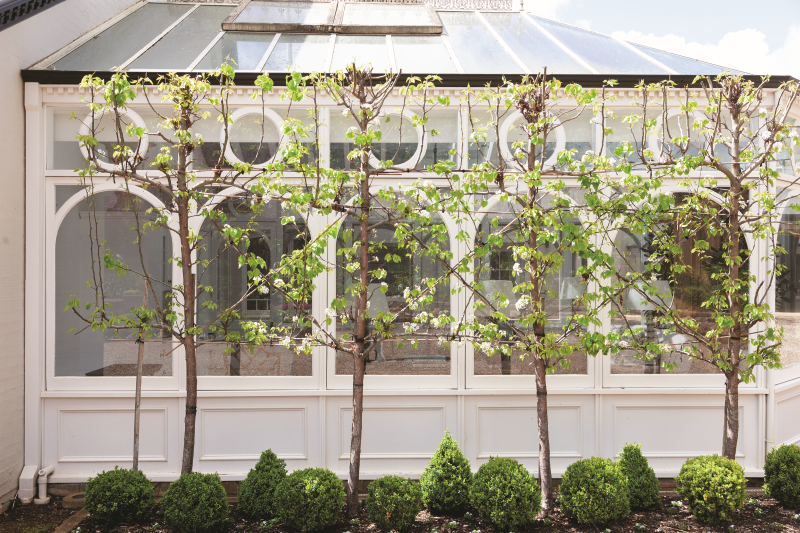
A pear-lined road leads down towards the western garden, the most recently developed area, which was begun about three years ago. In contrast to the aged patina and more classically structured elegance of other areas, this new garden is a bugle call to space.
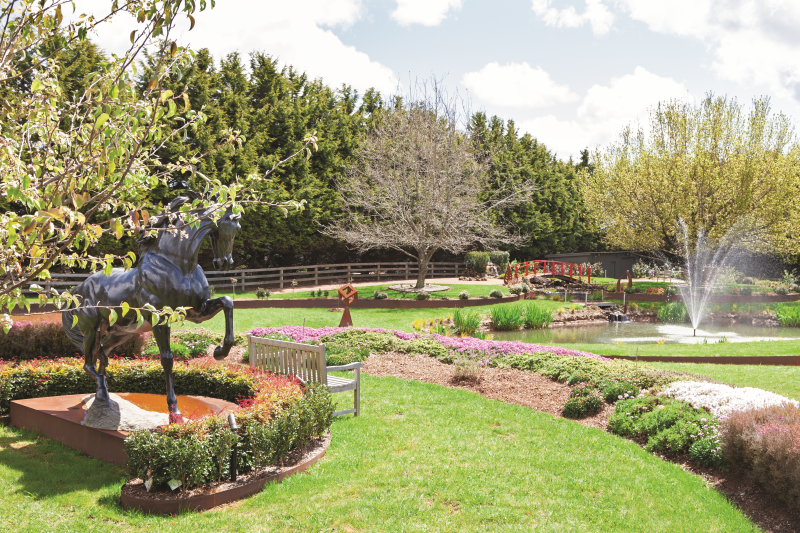
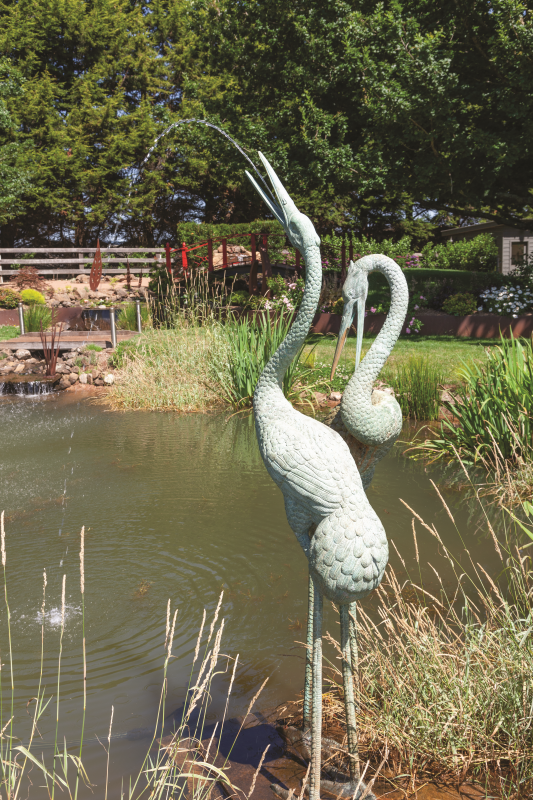
An impressive ebony-black Buchephalus, famous stallion of Alexander the Great, snorts and paws the air above the polo field and gardens below. While the polo field is only half-size, it’s still a mighty void, but its expanse works in tandem with broad sweeps of steel-edged swales and wide landscaped curves of the garden at its far end. A rocky rill runs under an arching bridge, down to a lake with a simple spray jet fountain, enhanced by water cranes at its edge.
Mature deciduous trees have been under-pruned to create a lifted canopy, and a barbecue, firepit, kitchen and toilets have been installed, making it a wonderful picnic area. Two as-yet small pines, grown from the seeds of Gallipoli’s Lone Pine, pay homage to John’s grandfather and father, who served respectively in the First and Second World Wars. Pink and white alpine phlox makes great ground-covering swathes of colour in spring, and a mix of tea trees, proteas, bulbs and perennials enliven beds along the far side of the barbecue area.
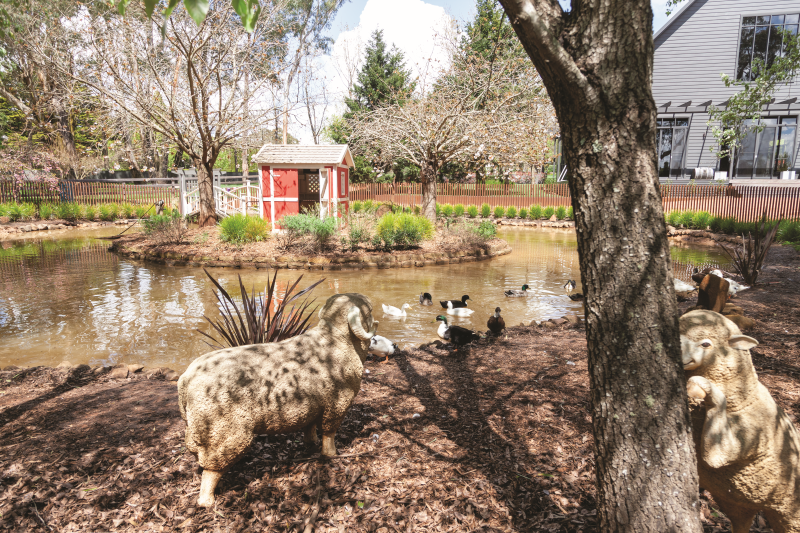
Between the polo field and a stylish duckpond there’s a walk featuring mid-sized Henry Moore figures, and behind the enormous barn built for Emily’s wedding reception, there’s a vibrant parterre garden.
“The parterre was already here but needed a lot of work,” says John. “We replaced beds made from wooden sleepers and redesigned it, using steel edging, and also constructed the four obelisks as a feature, which we painted teal.”
The name Thenford comes from the English village of the same name, home of John’s great-grandfather. Coincidentally, it’s also the place where former British MP Michael Heseltine and his wife Anne have developed their own extensive garden, Thenford House.
“The teal colour comes not from those people who have recently adopted it as a political identifier, but because it’s the colour of the obelisks at the Heseltine garden, which is magnificent. As well as admiring Michael’s political flair, visiting his garden and reading the book he and Anne have written about it has inspired me greatly.”
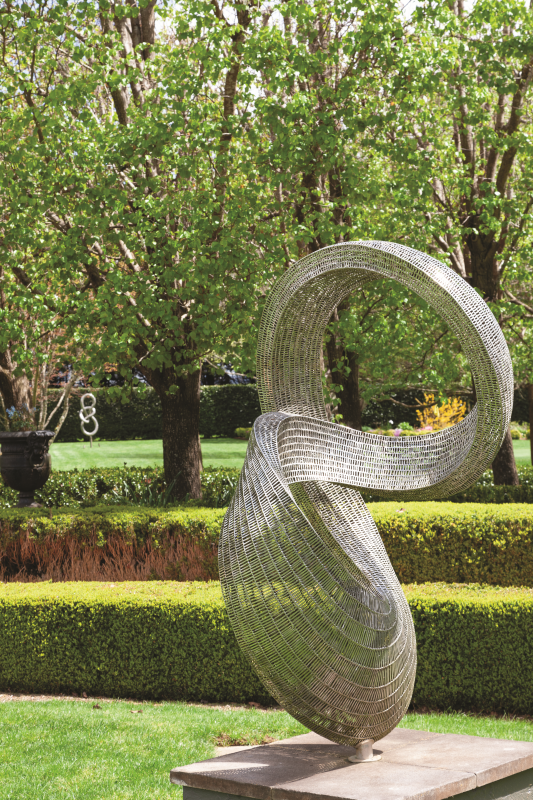
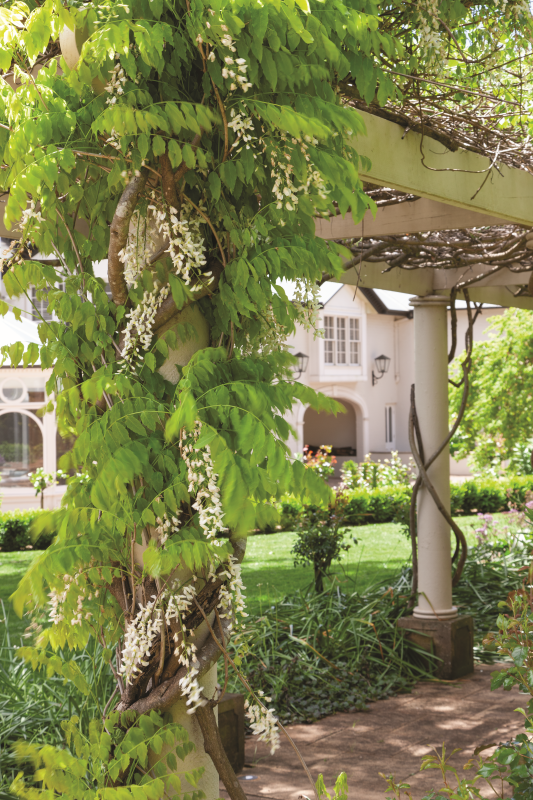
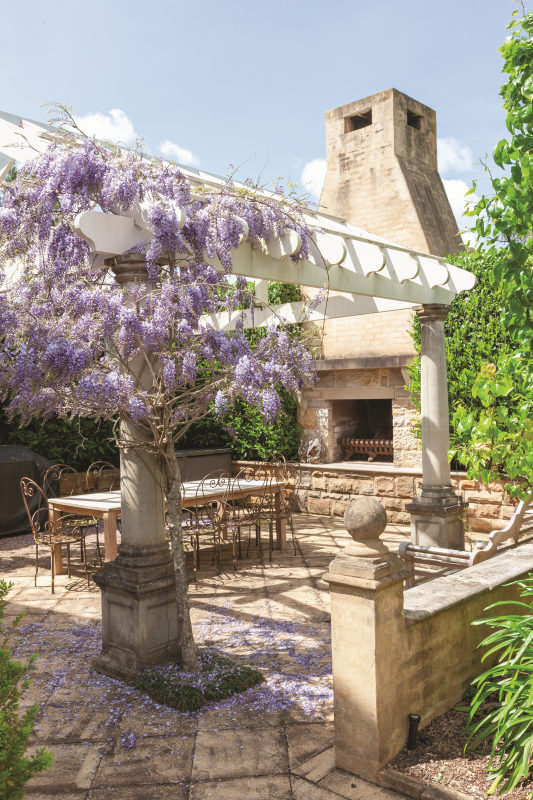
The parterre provides access to the upper gardens behind the house, which include a putting green, croquet lawn, tennis court and twin fountain garden, where four spiral-topiaried lilly pillies at each corner of the rectangular pool are an outstanding feature. Ornamental cherries, roses, azaleas, hydrangeas, wisteria, crab apples, autumn colouring trees and a dovecote mean it’s another place of beauty, whether sitting in quiet contemplation or being more active.
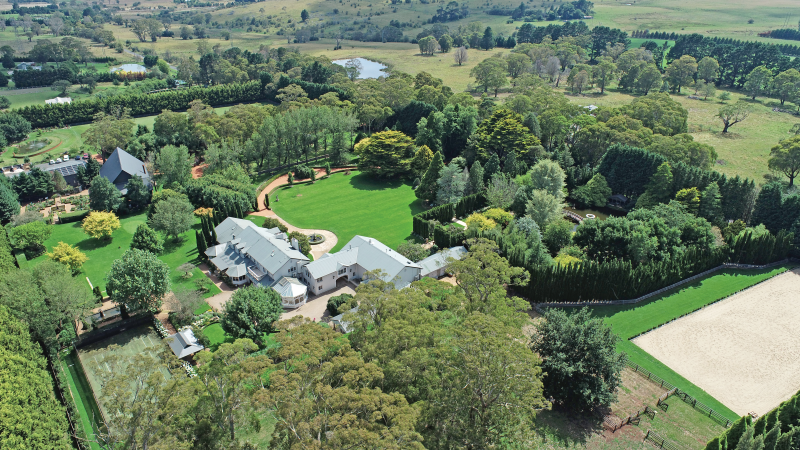
“There are so many parts of the garden that we enjoy, and it would be hard to pick a favourite spot,” says John, “but breakfast on the verandah overlooking the golden elm, or enjoying the scent of roses on a warm afternoon is pretty nice, as is a barbecue lunch in the shade of the woodland.”
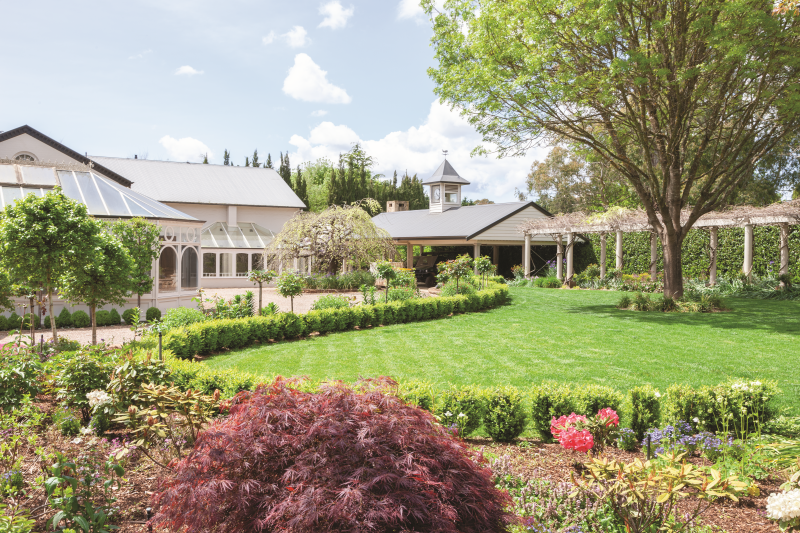
As with all gardens, work is never finished, and not surprisingly John has plans for a new garden behind the woodlands and adjacent to the sand arena used by the horses housed in his facilities next door.
“It’s a joint effort between myself and my team to come up with the plan for this new garden,” he says. “Everyone makes a contribution, and off we go.
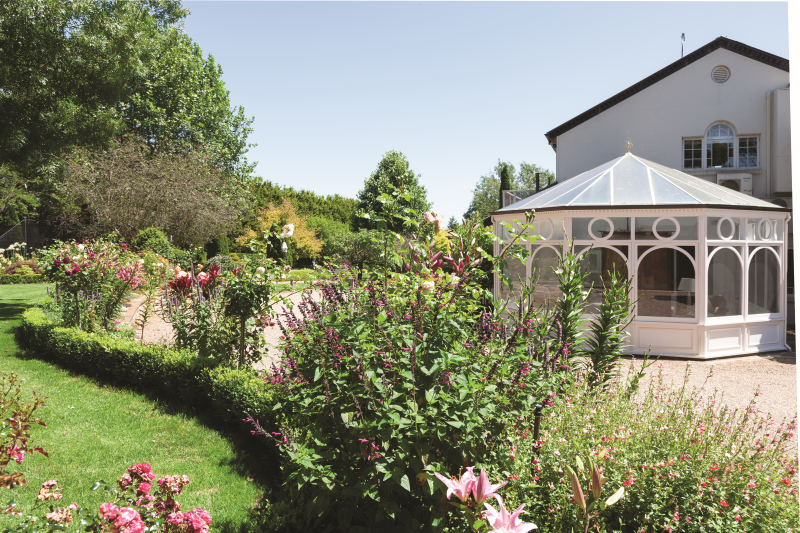
“We can take care of most things in the design, construction and planting of a new area, and there’s a lovely old oak already, which we’ll incorporate into the plan, and a magnificent stand of eucalypts in the horse paddock. It’ll be another exciting project, which I’m looking forward to very much.”

Back Issue April / May 2023 (PDF Download)
Relive the beauty of the Southern Highlands with this digital back issue of Highlife.
A garden wonderland
Over recent years, former politician John Sharp and six gardeners have been developing one of the Highlands’ most outstanding gardens, Thenford Lodge in Exeter.
The cottage that grew
A 19th century cottage with a 20th century extension was the starting point for a 21st century renovation in Berrima. Eric Savage and Clive West show us Old Rose Cottage and their many treasures.
What Emma did next
Emma Watkins, who found fame as the Yellow Wiggle, has reinvented herself as the signing character Emma Memma. She tells us about her animal-filled life in Robertson.
Ceramic simplicity
Ceramic artist Eloise Rankine and her sister, industrial designer Sophie, combined their talents to start Elph Ceramics in Exeter. Their minimalist pieces are increasingly attracting attention.
The original horsepower
‘Grow your own’ takes on a rare meaning at Marlie Draught Horse Stud in Exeter, where owner Aleks Berzins uses teams of his Australian Draught Horses to plough and harvest their own feed.
Native know-how
Having worked at Colo Vale’s Wariapendi Native Nursery for 20 years, Luke Maitland set out to build his own native plant business, Native Grace, in Robertson. He explains what natives have to offer.
A Fruitful life
Autumn is peak ripening time for apples and pears, which means peak preserving time for Kirstine McKay. Her Burradoo garden produces more than 100kg of apples a year.
A banks holiday
Bundanoon writer Huw Kingston recently walked the Banks Track, a three-day 31km hike taking in the wild and diverse scenery of New Zealand’s Banks Peninsula.
This is a virtual product. Upon purchase, you’ll receive instant access to download the magazine as a PDF. A secure download link will also be sent directly to your email, so you can revisit and enjoy your issue anytime.