View finder
Feb/Mar 2025
Photographs Tony Sheffield
For 10 years, architect/builder Darren Miller has been building the home that he and wife Natalie Miller designed for a stunning but challenging site in East Kangaloon. Natalie is also an architect and a renowned textile artist. They tell MELISSA PENN about their epic Grand Designs-worthy build.
You can’t see Natalie and Darren Miller’s East Kangaloon house from the road, which is just the way the architect couple likes it. Says Darren, who is also the home’s builder: “There’s a break in the trees then it’s a short drive to the front of the house where we’ve urbanised it with a simple courtyard and sliding gate entry.
“A lot of people in the Highlands go for the big entrance gates and the tree-lined gravel driveway leading to the grand house – it’s that Great Gatsby mansion idea,” he says. “Unless you drive down a nearby side road, you wouldn’t know this house is here.”
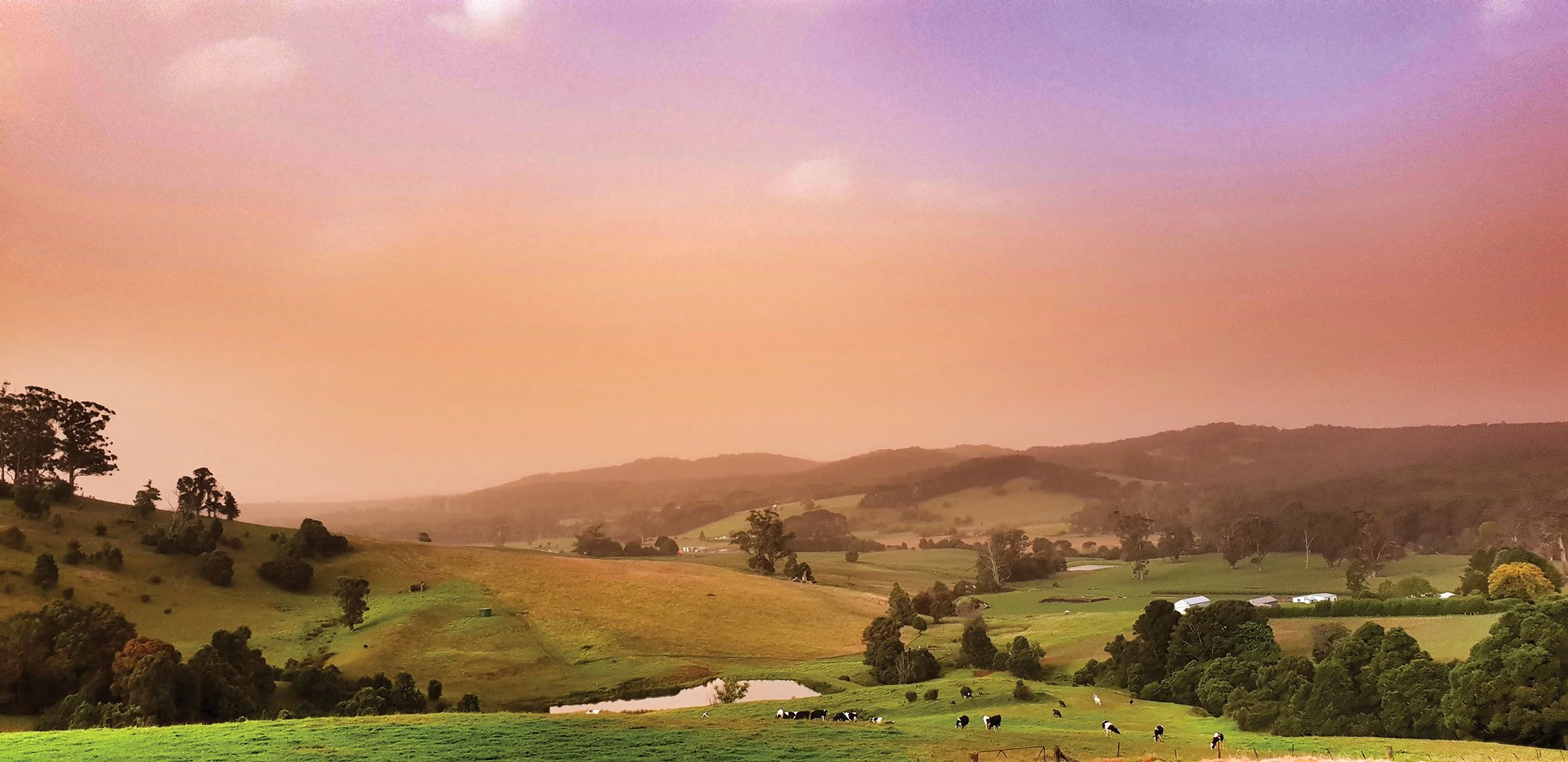
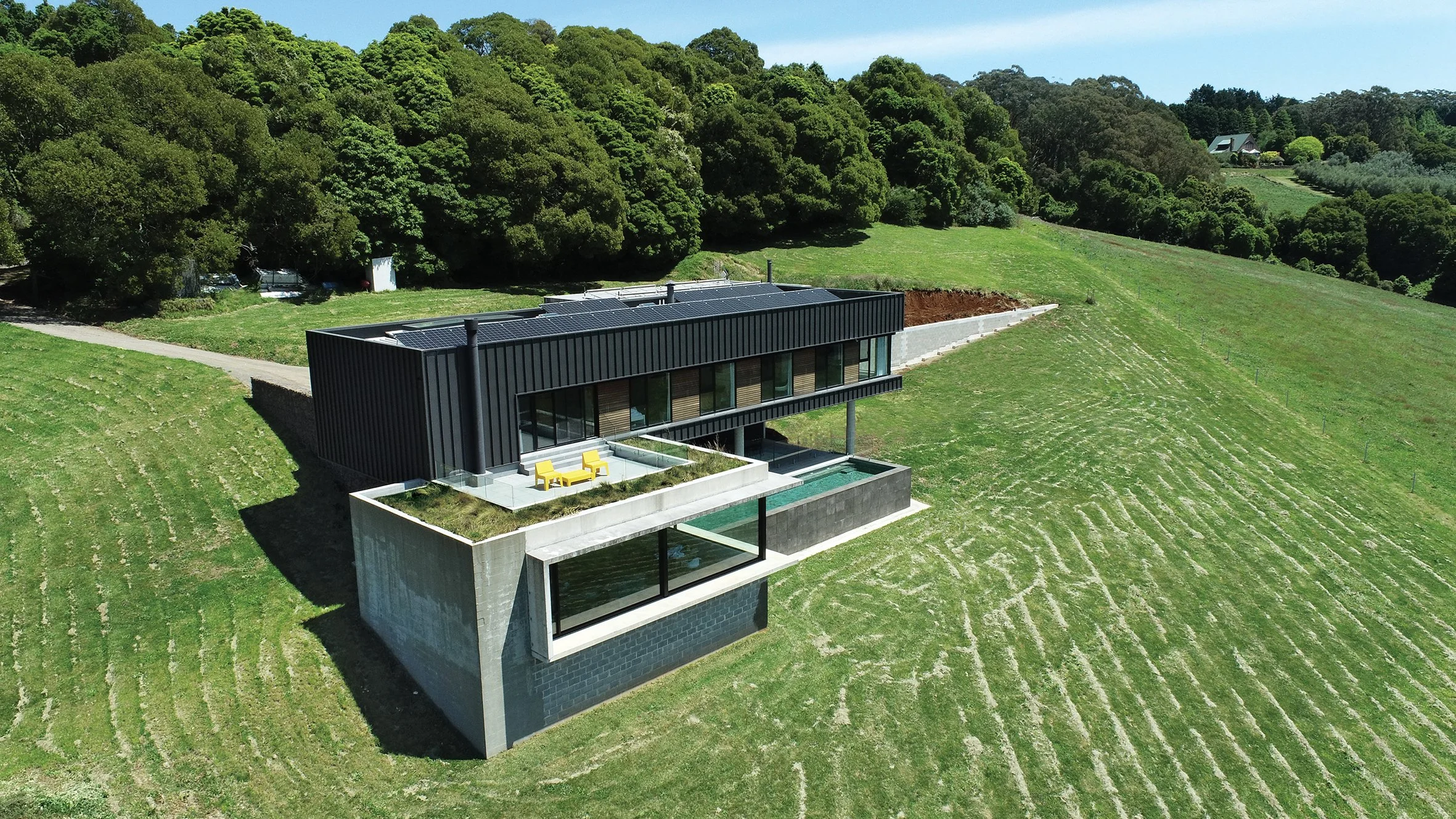
But the house is most definitely here. Constructed from concrete, black steel, glazing, timber and local basalt stone, the “very contemporary” double-level, five-bedroom, five-bathroom home is set on the side of a hill. Here it overlooks dairy farms, rolling hills and valleys and the start of the Nepean River, taking full advantage of its northerly orientation and jaw-dropping panoramic views.
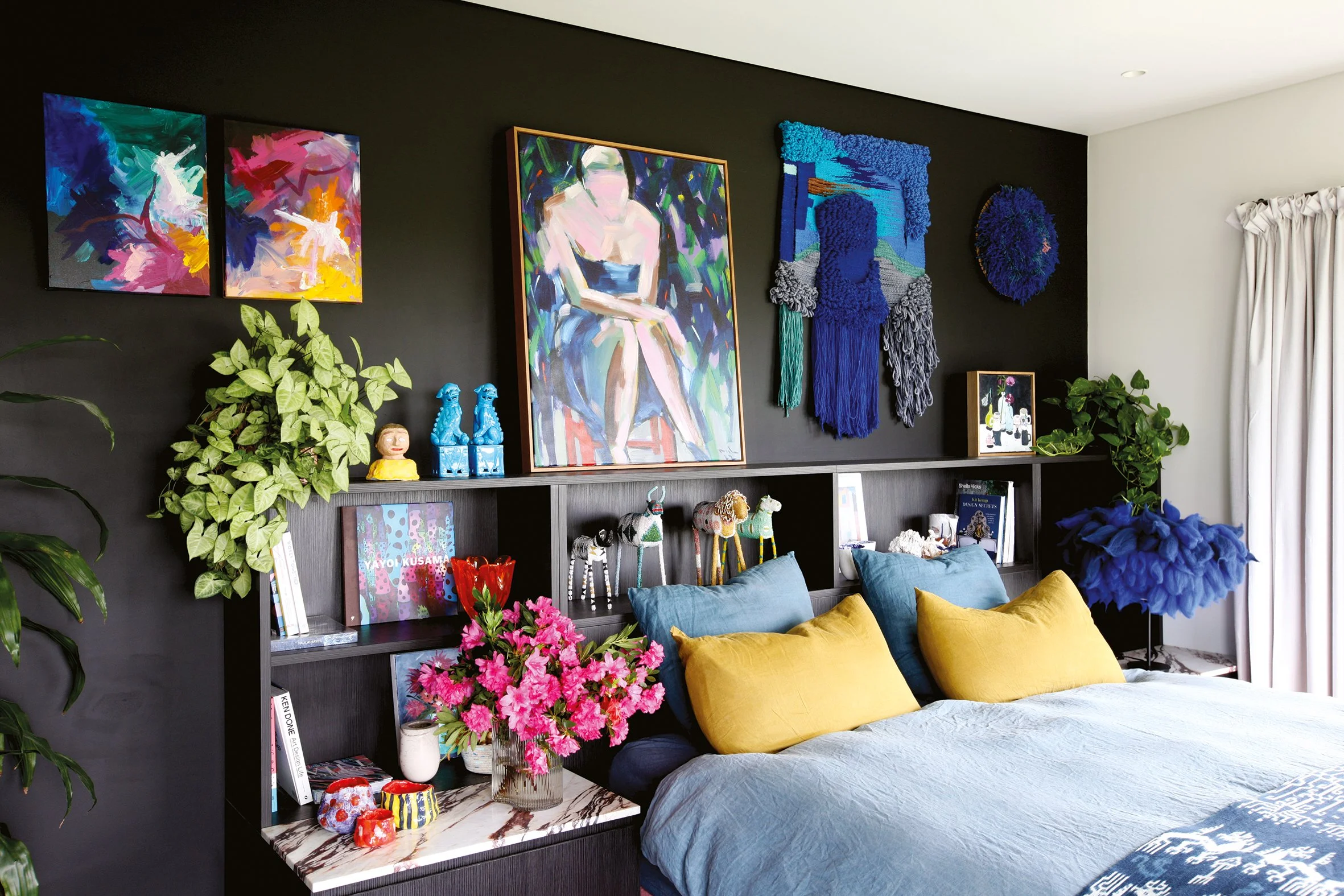
Natalie is also a renowned textile artist and the house is a showcase for her colourful woven works. Her tapestries are held in private and public collections internationally and locally, including at Berrima’s Bendooley Estate, where she was architect and interior designer for the 2021-built cellar door/Leo’s By Night restaurant. In November, one of Natalie’s designs was selected for Italian design house Fendi’s ‘Hand in Hand’ baguette project. Her tapestry works hang in places such as Brisbane’s Star Hotel, Emporium Melbourne’s Gorman store and The Clairfield Hotel in Mudgee. In 2016 Natalie designed and made the biggest macrame chandelier in the world for Hong Kong’s Pacific Place.
The five-acre property was on the market for around a year before the couple bought it in mid-2013 (they have three children, aged 25, 20 and 14). Says Natalie: “No one wanted to buy the land because it was sloping. It had power connected and there was even an approved DA – strangely for the construction of a house that would suit a flat block. We both instantly saw the potential and Darren’s been hand-building the house ever since, as money allows.”
The passive-design house was a collaboration between the couple, who have worked together on many architectural projects. It comprises a split-level main building set back into the slope, with an adjoining second building containing a garage, Natalie’s studio used for making, group workshops and weaving retreats, and a bedroom below. Electricity is generated from solar panels while water needs are managed via a 100,000 litre water tank under the garage fed via V-shaped butterfly roofs on both buildings.
Says Darren: “The site conditions and natural topography of the land determined the form and shape of the building. The windows are orientated to face north for the views and sun, and where there’s a corner, we have windows on both sides. The whole structure is built into the hill, which also means we’re largely protected from the westerlies.”
The house and most of the internal structures such as floors, walls, ceilings, steps and fireplaces are constructed from exposed off-form concrete, which is made when concrete is poured into moulds or formwork and left to harden, giving a variety of textured effects. The couple love concrete’s strength, durability and thermal qualities as well as its raw, industrial aesthetic. Says Darren: “We both love Japan where they use a lot of off-form concrete. They are big on understated design where nothing’s over-embellished – it’s about expressing the material. I wanted to carry that theme through this house.”
The house also features cladding in black standing-seam steel, vertical spotted gum timber boards and local basalt stone. Says Darren: “It was important to incorporate raw, natural materials from the local area while keeping the interiors neutral to show off Natalie’s colourful works.
“Natalie is strong on interiors and I’m more into the structural side of things. I get excited about the technical stuff like the new automated pool cover, which is where all the money goes,” he laughs.
One of the most striking aspects of the home is its pleasant internal temperature – 21 degrees year-round – thanks to under-slab foam insulation, double-glazed glass and European tilt and turn windows, and a German-made underground geo-thermal heat pump hydronic system. Says Darren: “I grew up in Canberra with a living room heated by an oil heater and the rest of the house was freezing. So when we moved here from Sydney we knew getting the heating right was a must – we didn’t want to be walking around the house in Ugg boots and jumpers.”
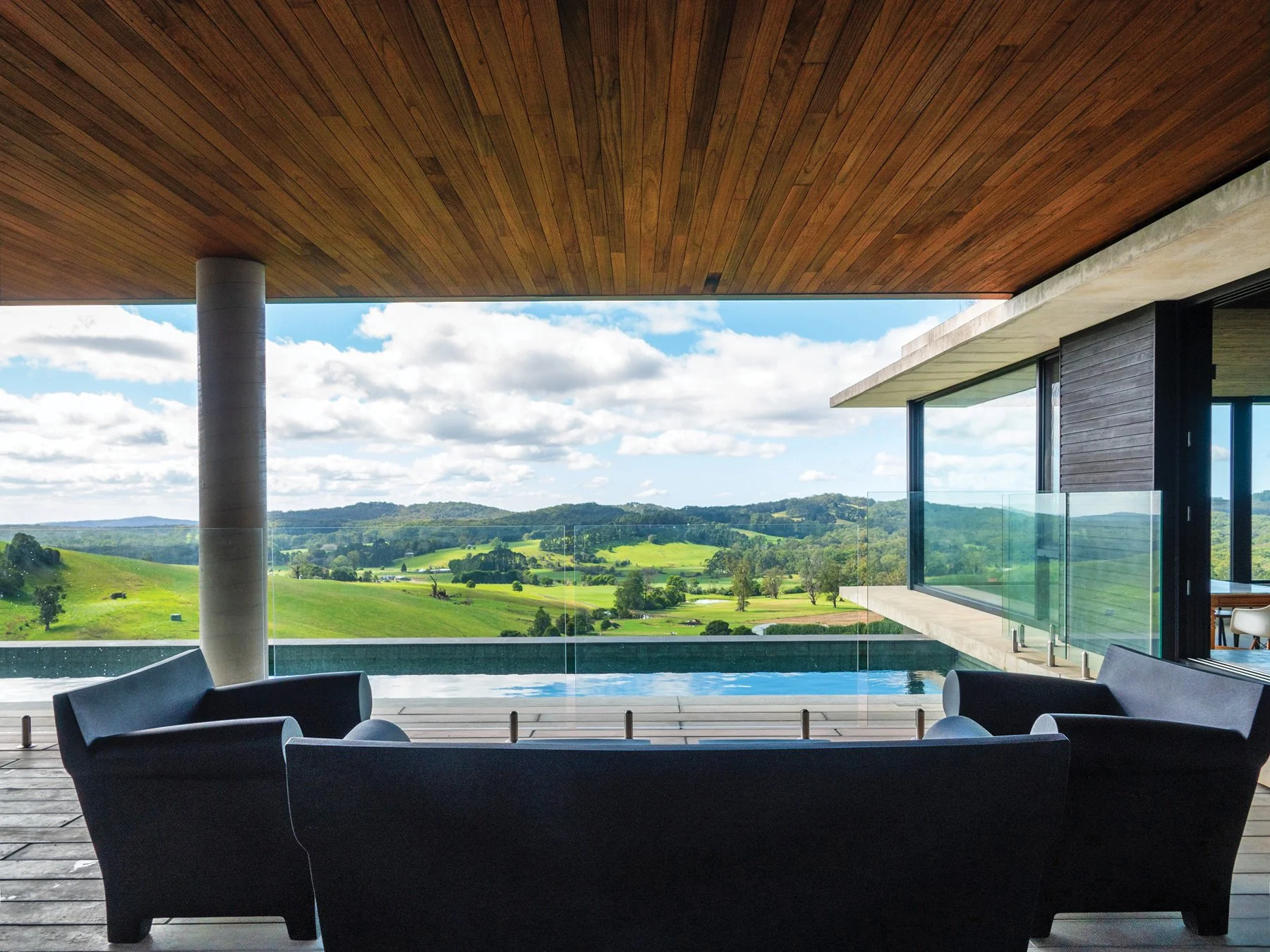
In summer, when the sun is higher in the sky, concrete hoods over the windows and external motorised blinds prevent sun penetrating the house. On very warm days the heat pump runs at about half the rate as usual and coolant in under-slab pipes keeps temperatures comfortable.
Darren began construction in early 2015. He used a raft slab foundation system – essentially, reinforced concrete on the ground strengthened with reinforced steel – to anchor the building to the slope.
“The hardest part of the build was getting the concrete trucks in because I had to create a driveway and I’d never done civil works before. I had a few issues with trucks getting bogged, so it was important to get the retaining wall in quickly. This allowed me to create a level working platform to allow us to get the truck with the concrete boom pump where it needed to be.”
For its visual properties, Darren hand-built a 5.4 metre high gabion wall to run in front of the retaining wall where it features in the living room and behind the pool area. It’s filled with local basalt rock Darren obtained from neighbouring properties.
“It’s amazing what you can get for a couple of cases of beer,” says Darren. “After ploughing their fields, the farmers had it stockpiled or lying around. I just drove my ute up and back, filling it with rocks then throwing them into the mesh baskets to make the wall. This basalt rock was one of the reasons we fell in love with the area, and it was essential to integrate it into the build. Everyone uses basalt for their entry gates, but I’d rather see it in my house.”
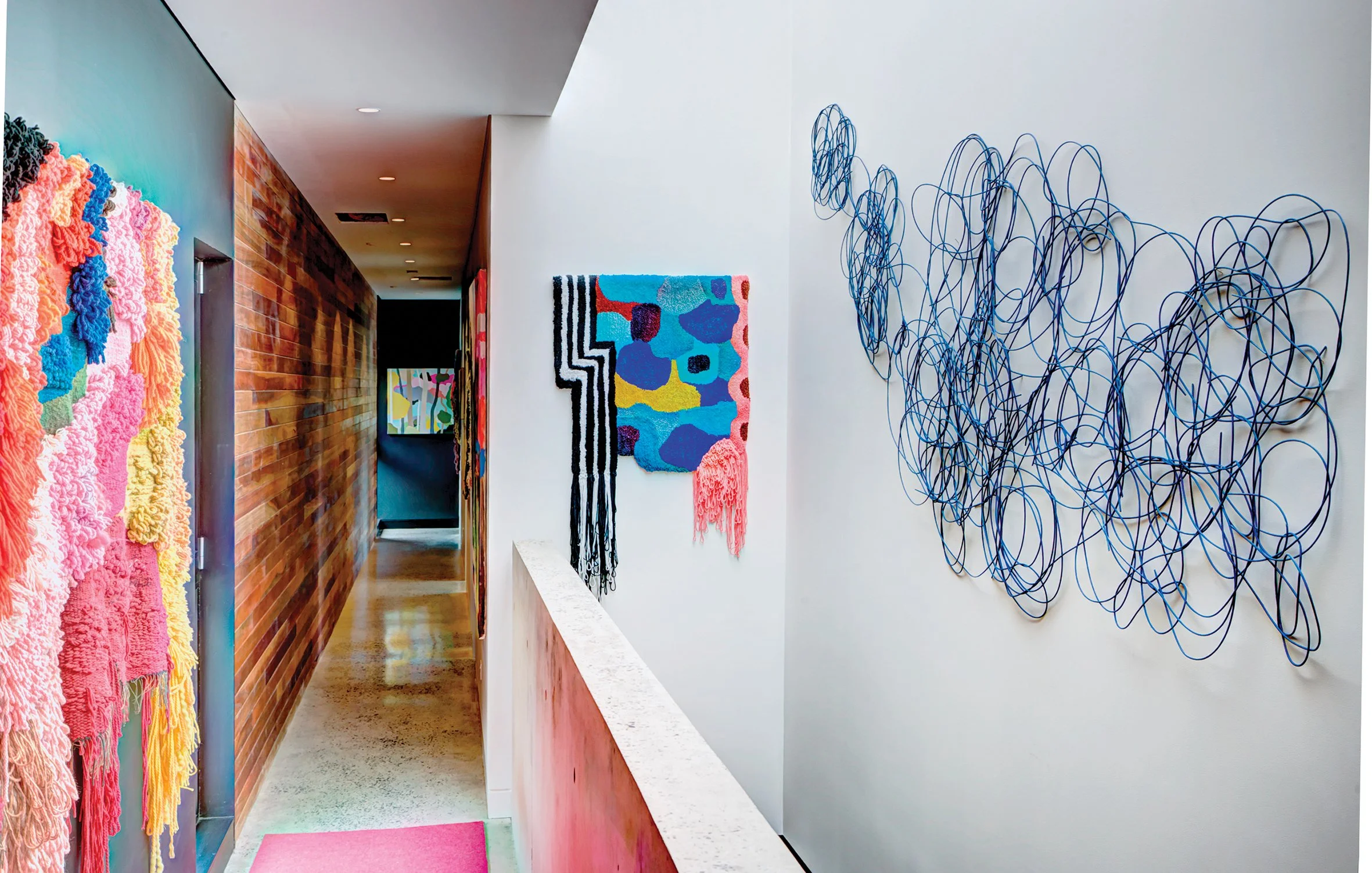
On entering via the top level, the house gradually reveals its location. There’s no sign of the views straightaway – instead, a long white entrance corridor (Dulux Natural White, used throughout the house) is decorated with Natalie’s tapestries and paintings. A skylight lets natural light and sun into the space, which has a dramatic black feature wall and is clad with spotted gum along the back.
Colour abounds here – there’s an eye-catching electric blue woven raffia work by Natalie (“I just twisted raffia then spray-painted it”) hanging above the stair void to the lower level, and a hot pink runner on the concrete floor. Darren put a semi-gloss finish on the floors on this level; the lower level floors were left matt. A green tapestry landscape by Natalie and a green painting by Melbourne artist Noni Drew hang side by side, hinting at the scenery beyond.
The main bedroom is at the other end of the corridor (past three bedrooms) and has vistas of the surrounding countryside and dairy cattle below. “The idea is that the room floats over the paddocks,” says Natalie. “The fencing is a minimal style and because we have grass only – no trees or garden – the view is uninterrupted.” Accessories in the bedroom are artworks made by her or items picked up on travels, such as the blue ikat throw on the bed from Sumba in Indonesia.
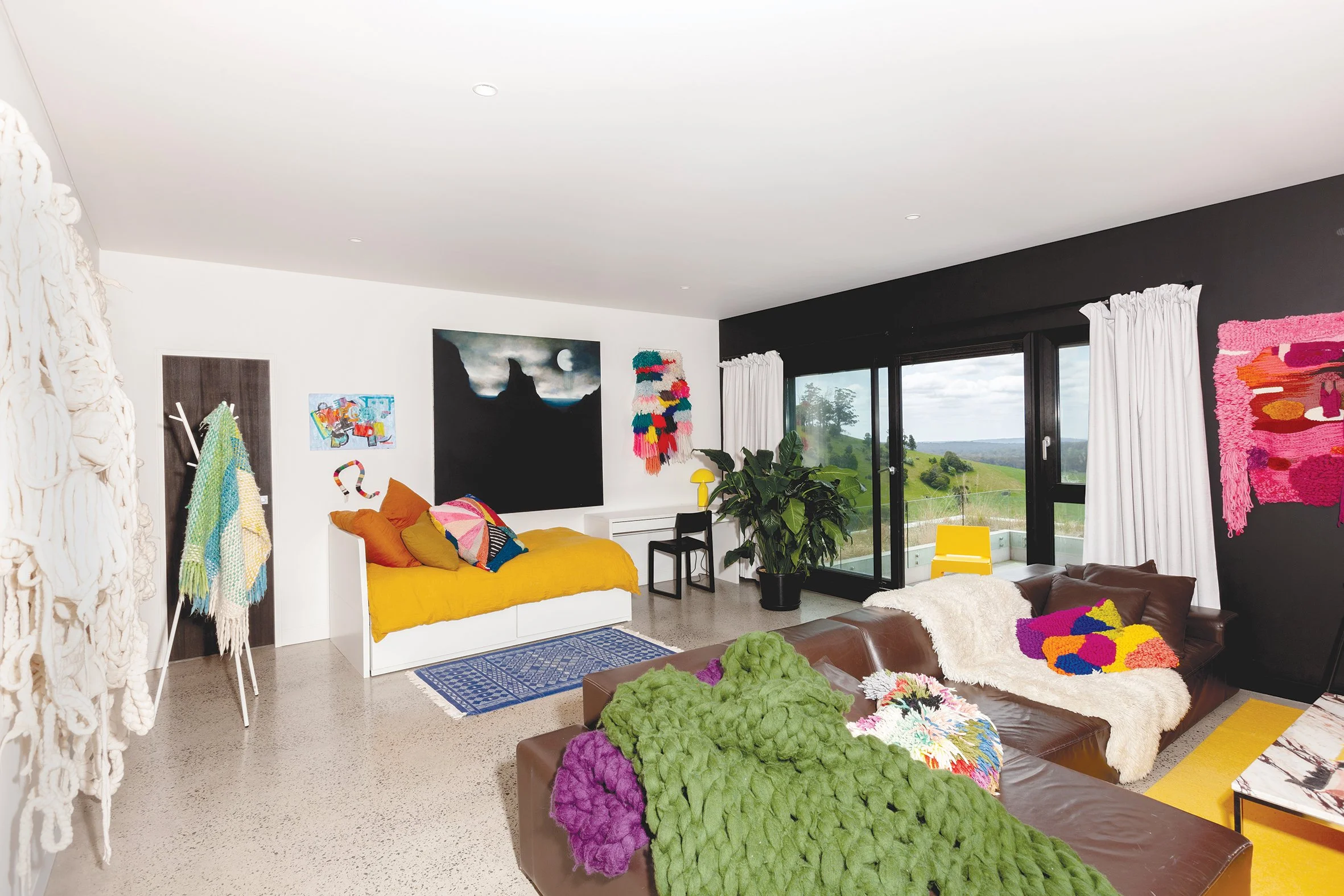
The media room is off the entrance corridor and reveals a perfectly framed view through huge black-framed glass doors and a black feature wall. An L-shaped brown leather lounge is made inviting with Natalie’s colourful hand-made cushions and chunky arm-knitted blankets, and tapestry works hang on the walls. This room leads to an outdoor terrace surrounded by a rooftop garden of kangaroo grass where the couple often have friends over for cocktails and dancing. It’s also the perfect yoga spot, says Natalie.
From the entry, concrete stairs lead to the star of the show, the large main living room with 180 degree views of the landscape through large windows. Installing these windows was a major undertaking for Darren. Each weighs around 250 kilograms and was trucked in before being craned up and over scaffolding and into place in a delicate operation that took around a week. Each window was then made airtight with foam filler applied around the frame to further insulate the house.
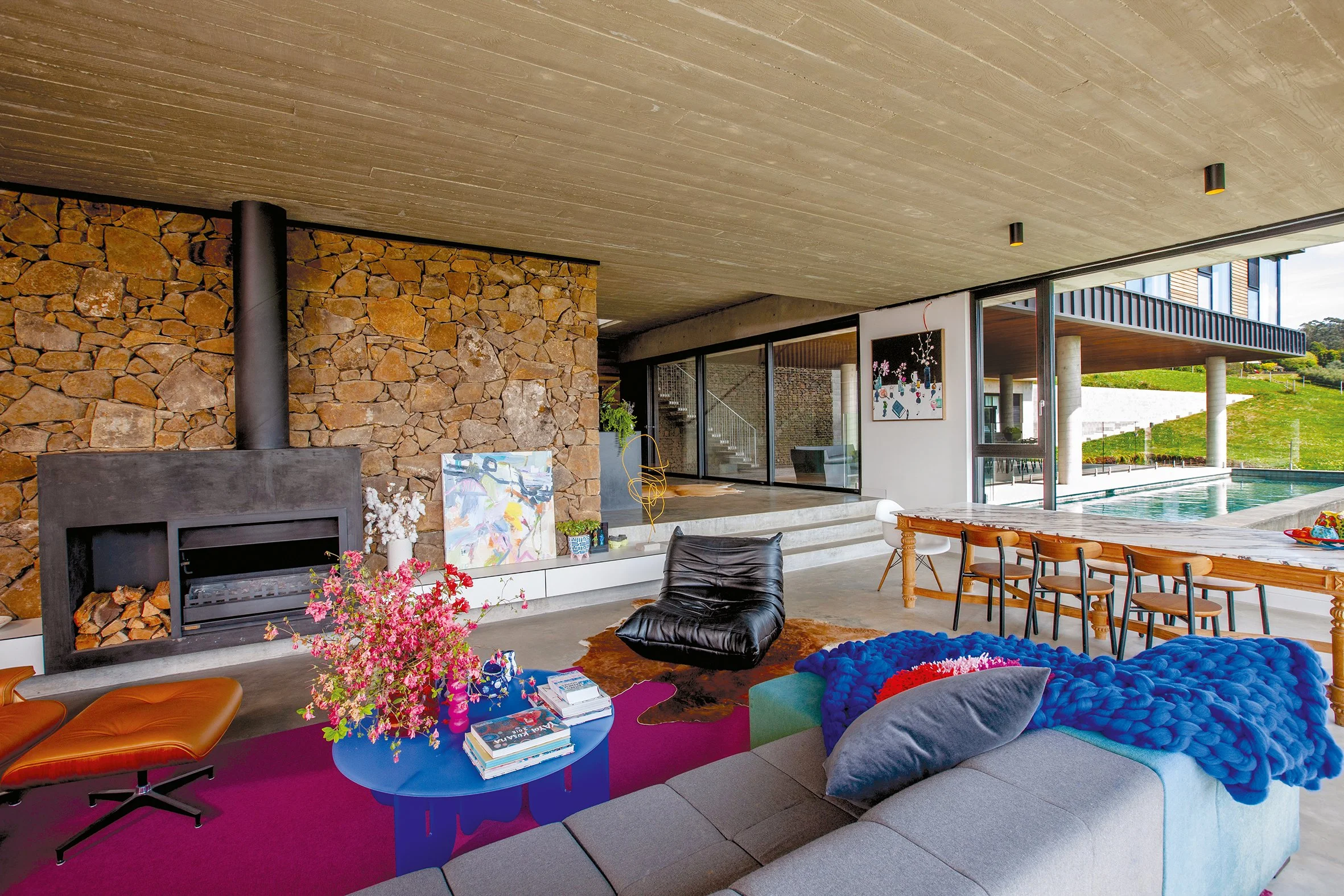
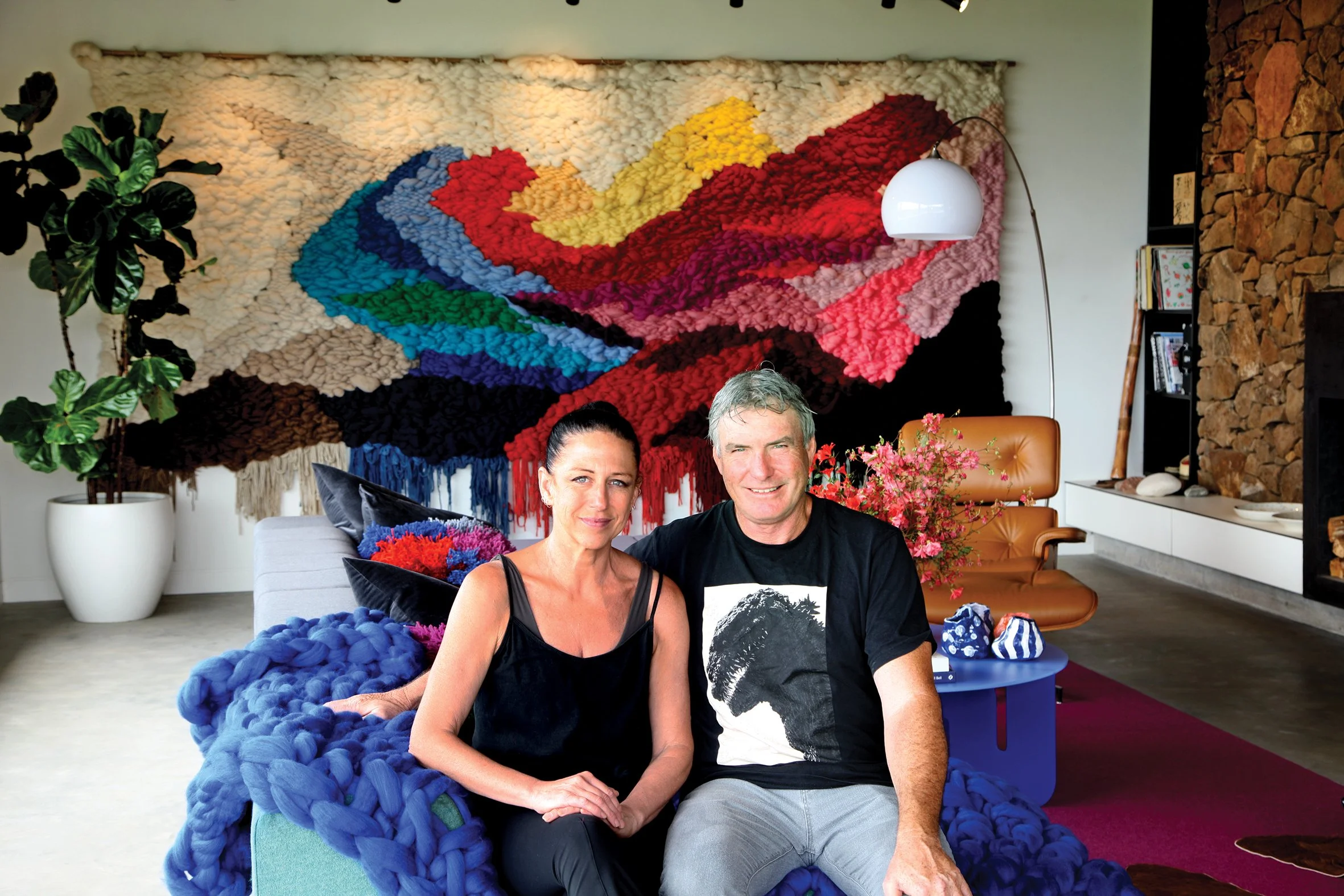
A five metre x three metre work, created by Natalie in a live demonstration in Sydney’s Pitt Street for a collaboration with Woolmark in 2018, hangs on the living room’s main wall, and her hand-woven cushions and blankets adorn the slimline modular couch. Says Natalie: “I knew I wanted a hot pink rug in here and we initially had a different acrylic coffee table. A friend was dancing on it one night and it broke, so we replaced it with this one from Melbourne interior store Fenton and Fenton.”
For the colour scheme throughout, Natalie says there was no real plan. “I like all colours and I think they all go together. For me, there are no rules about what goes with what.”
The ceiling is timber-patterned off-form concrete made by Darren using Douglas fir moulds (they repeated this ceiling in Natalie’s workshop). Says Natalie: “Ten years ago you could buy a huge pack of Douglas fir timber from Canada for about $1000 but timber has become so expensive you can’t do it anymore. Now to have this look they use fake formwork, and it looks fake.”
Darren is particularly happy with the dry-stacked basalt feature wall surrounding the off-form black concrete fireplace. To make the wall, Yorkshire-born local craftsman Rob Moore used the centuries-old technique of dry-stacking to arrange and interlock every stone. “None of the rocks are cut – not even the corner ones – because if you cut basalt it goes grey,” says Darren. “It’s brown because it was buried for millions of years. Rob would go out walking and he found every single stone. I called him the rock whisperer. My favourite place to sit is on the lounge looking at the flames in the fireplace and at the wall.”
The minimalist kitchen is up several steps from the living room past a still life by Robertson artist Kate Vella and has views to the pool and a slick outdoor terrace and barbecue area with black furniture. The large kitchen island is made from black porcelain and has a built-in sink and induction cooktop with integrated rangehood. Pantry, fridge and butler’s pantry are all concealed behind tall handleless cupboards.
The concrete-edged pool was completed and filled for the first time in December 2023 after Darren took around six months to lay the tiles. “I bought the tiles in Indonesia – all the pools in Bali use them and we wanted that look. When I got them here, the glue people told me I would have to use a special epoxy glue with a slow cure time, which made it more difficult – but they will never come off.”
Looking around their home, Natalie and Darren say that there’s deep satisfaction in having built something unique and to their taste.
“As architects, you’re always thinking of ways you could do things differently,” laughs Natalie. “But I love the ever-changing views – you get the beautiful sunrises, you get mist in the valleys, you get sunsets lighting up the whole forest.”
Says Darren: “When the sun goes down in the afternoon, the light goes the whole way across the landscape. It’s magical.”