Garden groove
Feb/Mar 2025
Photographs Tony Sheffield
In the decade since singer-songwriter Leo Sayer and Donatella Piccinetti moved to Berrima, Donatella has created a lush and lively garden using asymmetry, vibrant plants and surprise factors. “It is a really magical place to be,” Leo tells FRANCES SIMONS.
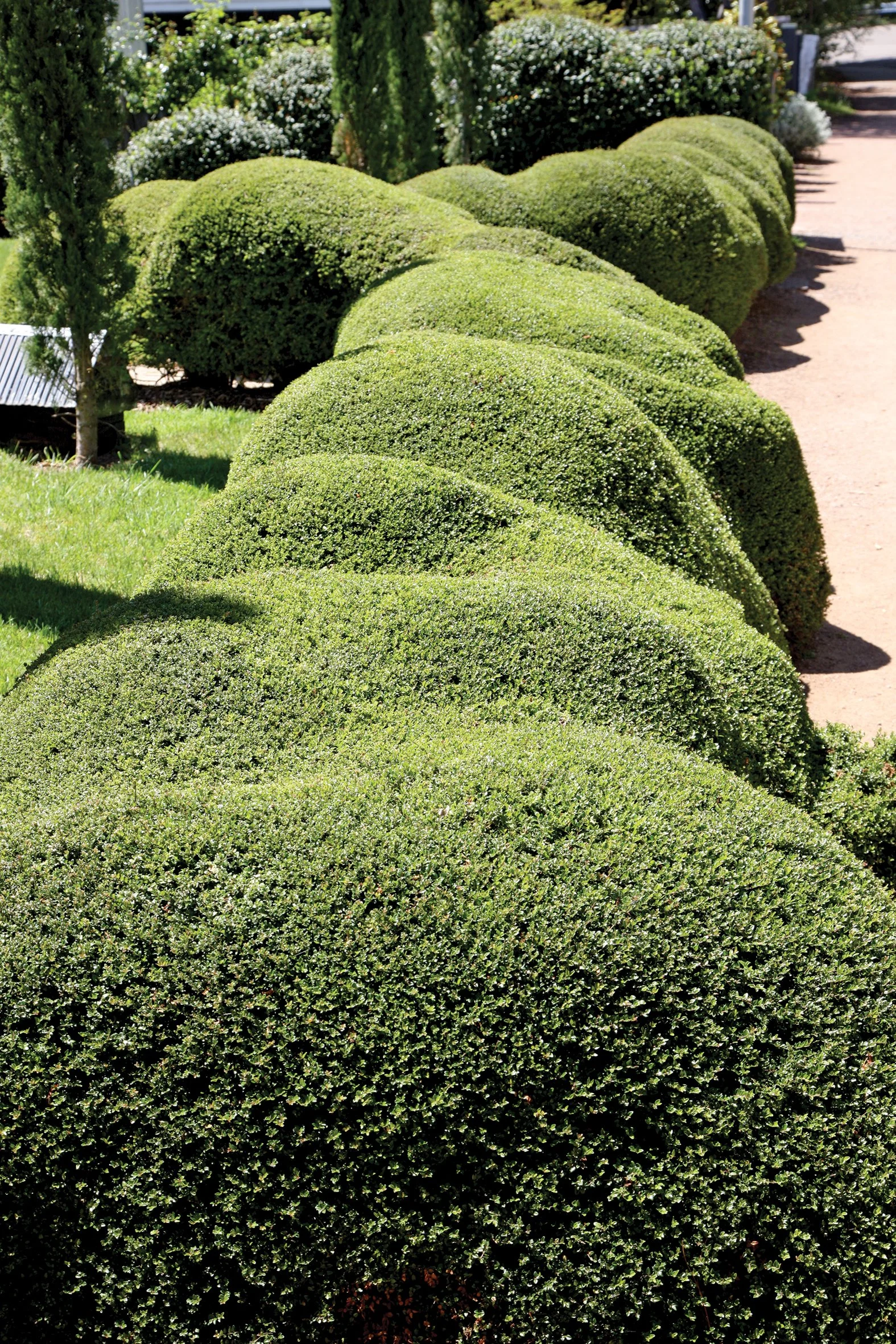
Precision clipped evergreen hedges are often hallmarks of garden formality. But not so the flourishing row of Lonicera nitida that marks the front entrance to Donatella Piccinetti and Leo Sayer’s Berrima garden. Curvaceously trimmed both top and sides, its dynamic undulations are lively, organic, spirited. In fact, mmm, it makes me feel like dancing.
Leo’s songs are an embedded soundtrack for boomers, with his many hits equally loved and recognised by millennials. A singer and songwriter since the early 1970s, he is an enduring perennial in the garden of pop, where many other talents bloom only to fade with the seasons. But in respect to the couple’s garden, it is Donatella’s artistry that has composed and produced the very personal song it sings to them both.
Asymmetric, flowing, a tapestry of flowers, colours, foliage, shapes and materials, the garden has been Donatella’s particular passion since the couple moved to Berrima in 2015.
“I was born in Florence and grew up surrounded by the beautiful Tuscan landscape, then lived, studied and worked in England for many years,” she says. “I gardened there when I had the time, but I found gardening in Australia to be very different. The climate, the plants, the soil. I had to learn so much.
“When we eventually settled in Berrima, I was fortunate to meet Ali Mentesh [owner of Red Cow Farm garden in Sutton Forest] and Jan Weeks, who has since sadly passed away. We used to meet at Jan’s cafe – The Magpie Cafe – and talk about gardens. It was lovely. Their passion for plants and their huge knowledge of roses, which I especially love, was such inspiration to me.
“Until recently, Ali worked with me here once a week for several years, and right now I’m grateful to have the help of Ben Neilsen, who can always find a solution for anything that needs to be done. And over the years I’ve had such help from Craig Meldrum too, who amongst other things has done our wonderful rockery work.”
One of the first things Donatella did with the garden was to consider the front hedge. “At that time, it was really just a long row of individual bushes, not well shaped, and it looked to me very segmented. Like a big green caterpillar. I decided to grow and shape it into something more organic, more interesting. I like it that so many people now say to us that they’ve always noticed our front hedge and it makes them smile.”
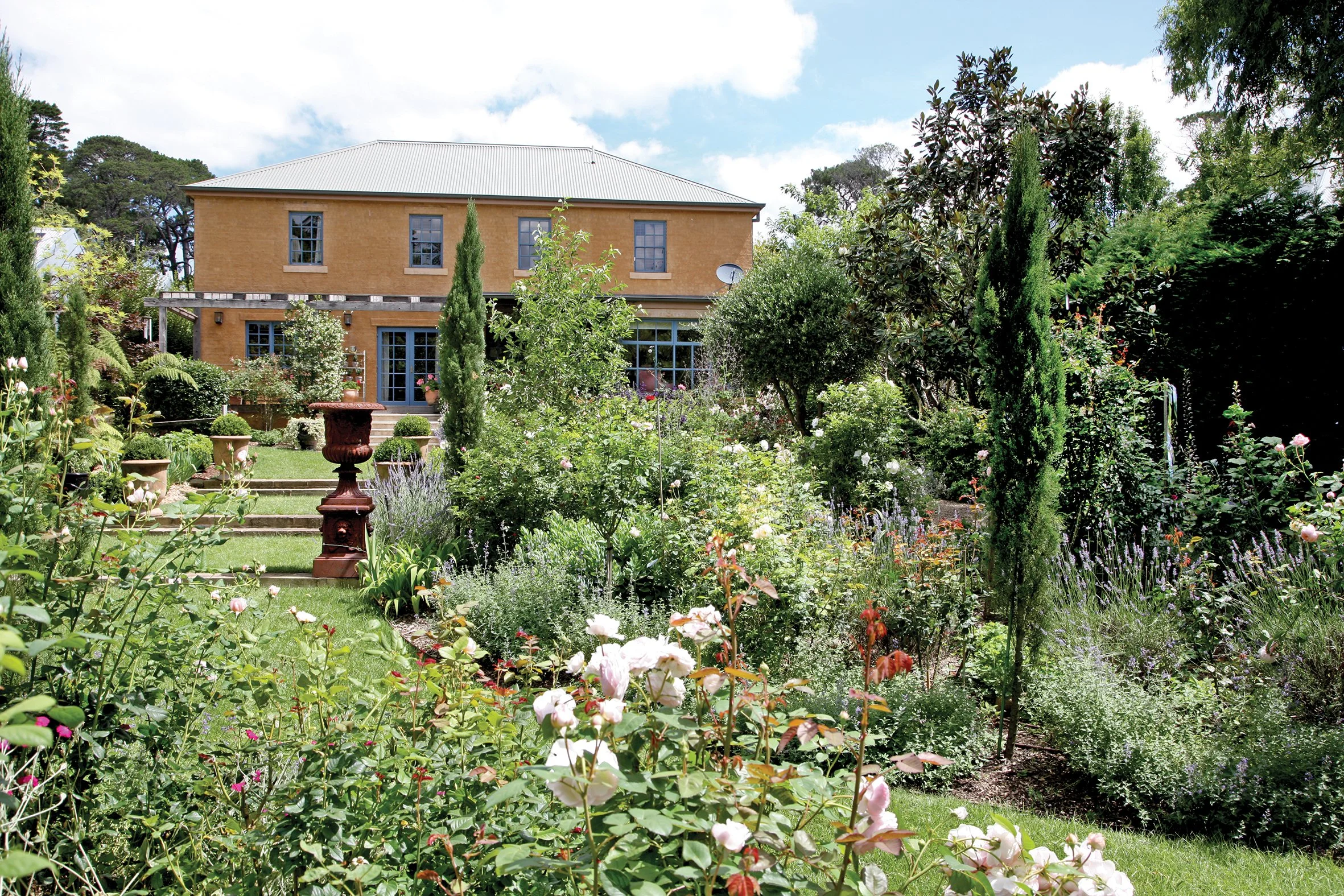
The couple’s half acre block is long and narrow, with three distinct garden zones. The first and front area surrounds Leo’s studio, the second stands between studio and house, and the third and largest section is at the back of the home.
The front garden is simply planted with pencil pines, buxus, maple and acanthus. A maple shelters a wondrous clump of dark purple inky-spathed, speckle-stemmed, shockingly endowed and foul-smelling voodoo lilies (Amorphophallus konjac). Not a plant to be placed just anywhere, especially not near doorway or seating areas, it is a frost-tender native of warmer subtropical Asia. Nevertheless, it is very happy alongside their gravel driveway.
Behind the studio stands a tall hedge-wall of closely trimmed cypress, unadorned by the fanfare of any supporting or decorative structure. A simple archway cut into its greenery is small in relation to the overall size of this living wall and intriguing for the suggestion that it that would rather keep itself, and whatever world lies beyond it, a quiet secret.
Stepping through the arch, into the middle garden, the magic it protects is revealed: an avenue of tall olives through which a flagstone path leads onwards through a sunken garden to the front door of the couple’s home. Spreading upwards and slightly inwards, the trees’ branches meet high above the central pathway. Flanked on each side by green lawn, one side furnished with a simple table and chairs, and the other by a font-like fountain, the olives create the shaded sanctuary of a living cathedral. When uplit at night, this illusion intensifies.
While the cypress hedge and the olives were in situ when they bought the property, Donatella has shaped them to enhance their arching effect.
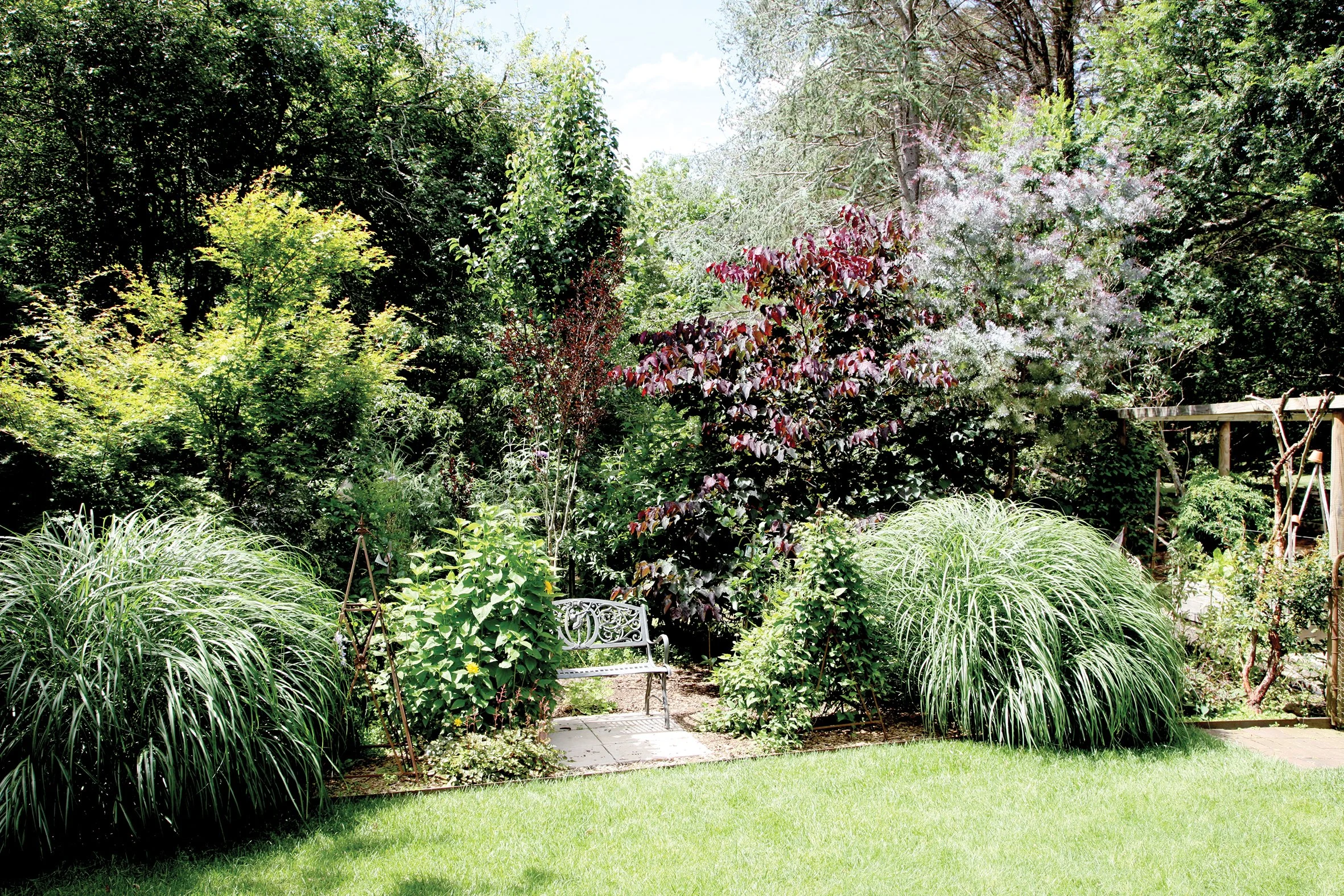
“We often have dinner here in summer,” says Leo, “and it is a really magical place to be. And we have that feeling about the whole garden really. We made it for the birds, for the bees and other insects, for the wonder of living things.
“Apart from it being an absolute sanctuary for me as a songwriter, I also love taking pictures of our moths, butterflies, spiders, birds and flowers. They are all so incredibly beautiful to me. I do get into a bit of trouble sometimes calling Donatella away from what she’s doing to come look at another ‘something special’.”
Beyond the olive allee, Donatella developed the sunken garden on both sides of the front door path, set below a teucrium hedge. Her inclination for organic form and pictorial tapestry is clearly apparent. She uses the same plants on each side – roses, daphne, salvia, weigelias, hydrangeas, geranium, dianthus, camellia – but they are not symmetrically mirrored in their positioning. This clever asymmetry achieves the harmonising effect of repeat planting without the stiffness of formal pairing.
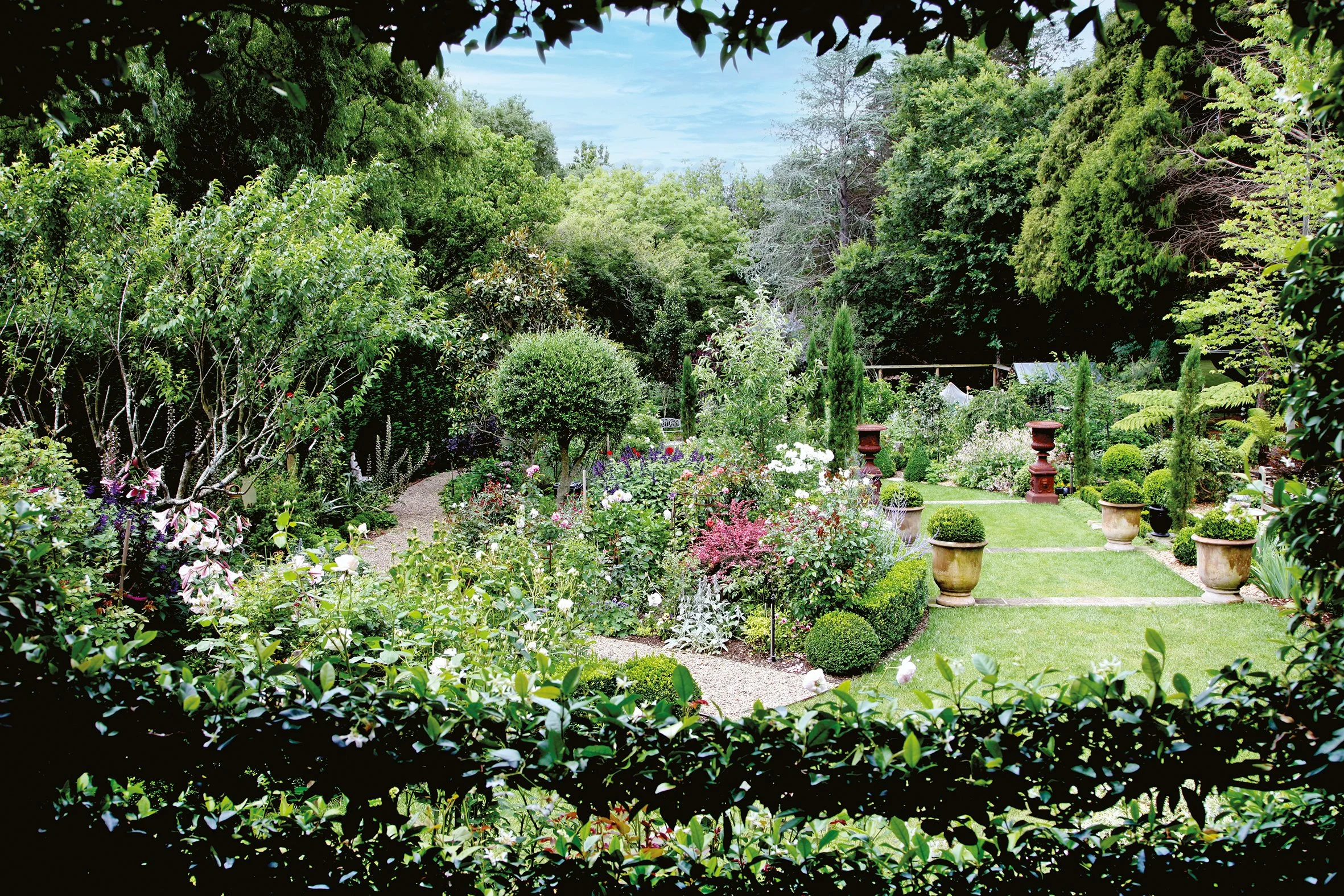
Her major project has been to transform the large garden from the collection of fruit trees and acanthus that it once was to a picture of flowing abundance and stylish artistry. Looking out from the house, the area stretches gently down and away, with curving gravelled paths as well as more linear grassed walks. This is where the couple got married in 2023, after 40 near-continuous years of togetherness.
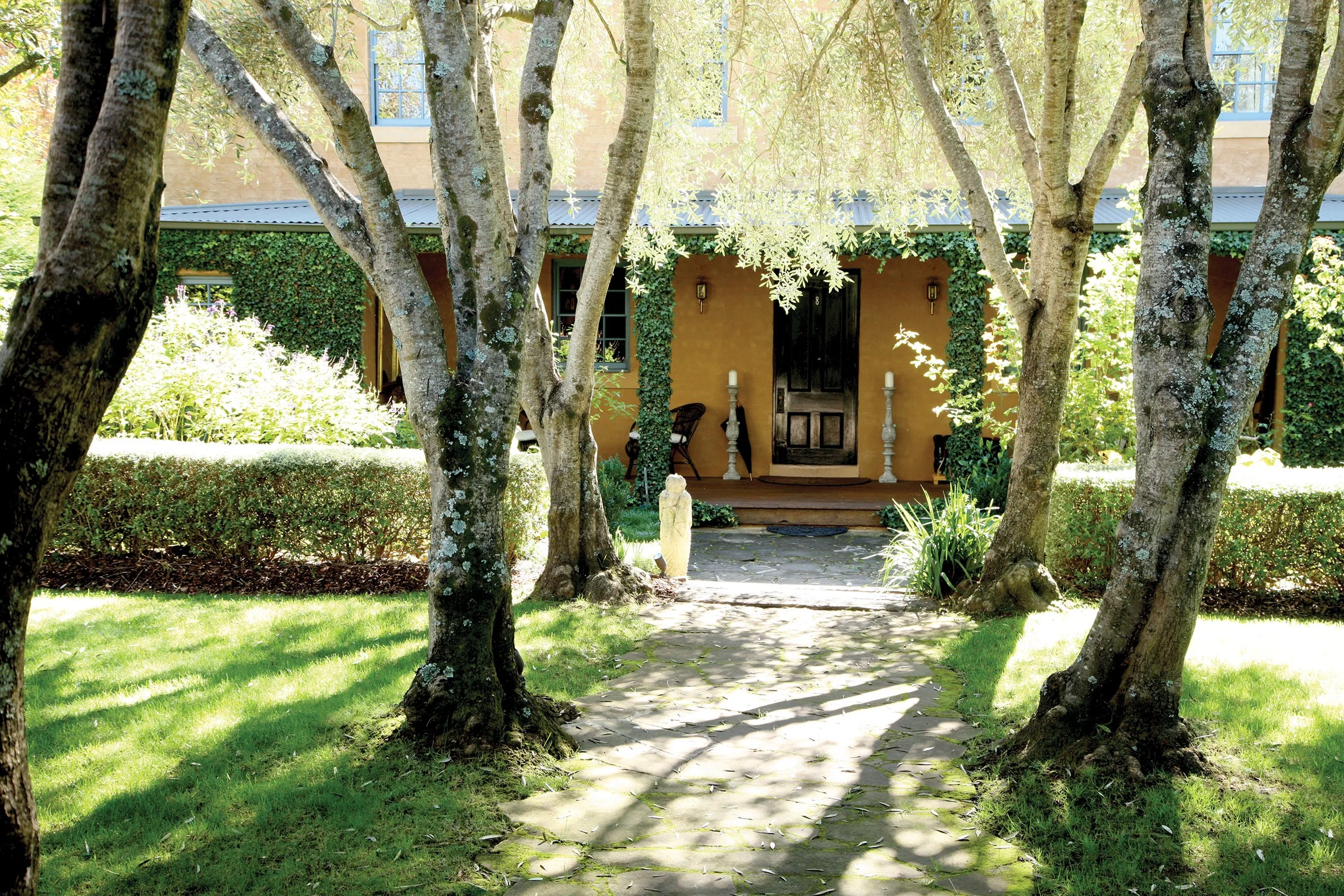
Formality via tailored buxus shapes of balls, squares and cones, a pair of dramatic rust-coloured urns on tall pedestals and a small, paved parterre mix with an overall design outcome of ebullience. Glorious shrub and climbing roses, swaying lavender, groupings of lupin, phlomis, iris, tulips and foxglove, and plantings of dahlias, gladioli, allium, sunflowers, sedum, hollyhock, nicotiana and aquilegia all come and go as the seasons change.
They are set against dramatic foliage colours of golden physocarpus, crimson berberis, dark Angelica, purple Cootamundra wattle, burgundy forest pansy, deep brown crepe myrtle, black sambuca and greens of all shades. Adding to the contrast and diversity within this interesting and beautiful garden are tree ferns, thalictrum, olive, magnolia, clematis, crab apple, monkhood, dicentra, rhubarb, canna, astilbe, lemon verbena, buddleia, miscanthus and viburnum.
“It’s not for me those gardens of a closely matched palette,” says Donatella. “I like the vibrancy of mixed colours. It’s the proportions and shapes of those colours in relation to each other that is the important thing.
“I also favour the organic feel of curves and asymmetry. Ali and I were a bit different in that respect. I’m sure he would have generally preferred more symmetry and a straight design axis, but he never imposed his preferences over mine, which I really appreciated. And he was so good in suggesting what plant would do well in what position. We spent a lot of time and effort together feeding the soil to make it rich and nutritious, and that has really paid off in terms of how well things grow. I don’t like using poisons of any sort either. Insects, birds, lizards, everything has a place here.”
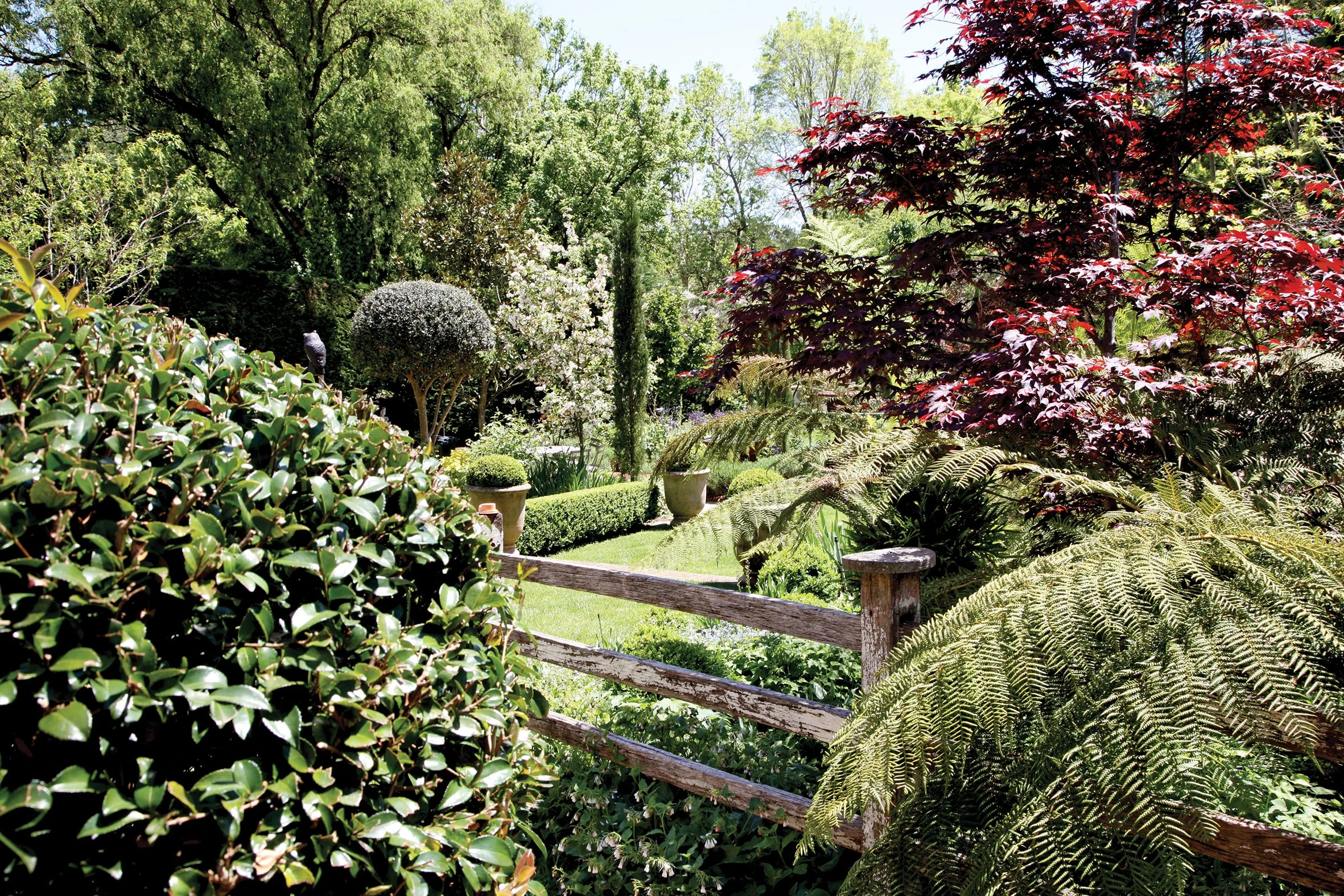
Donatella’s motivation towards compassion for all living things is reflected by a small statue of Buddhist goddess Quan Yin, set within the hedge that borders the western side of the garden.
“She looks over everything with quiet wisdom,” she says, “and her legend is my favourite story. Sent away by her father for refusing to obey him, she lived quietly in a cave, assisted by nature. Years later, when no one else would help her dying father she returned to him, with love and compassion for his situation. I like that compassion to be here, flowing across the garden.”
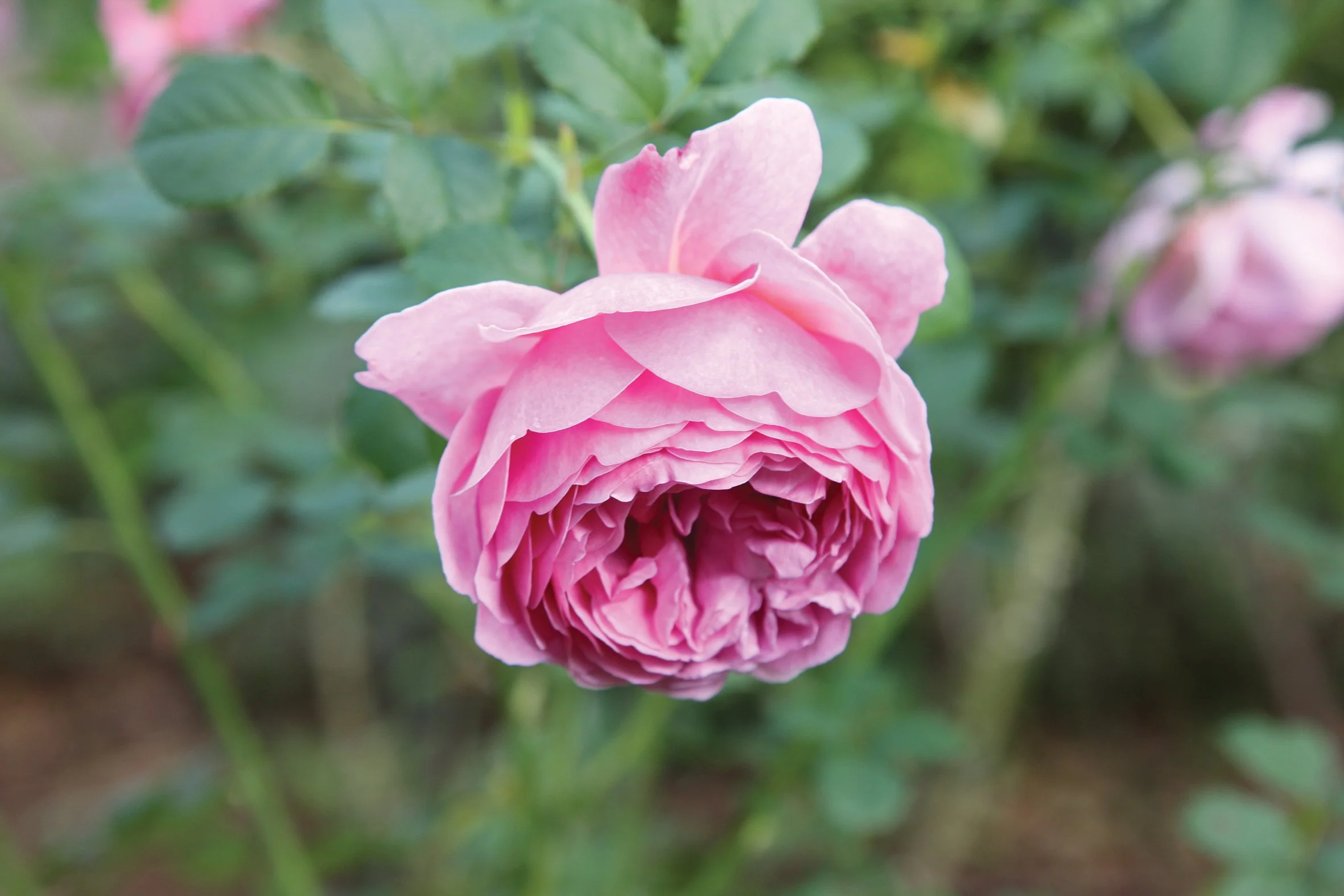
Donatella’s love of roses sees them appearing everywhere, as opposed to contained within a dedicated rose garden, including along the trellis above the vegetable patch, and up the arbour above the paved seating area. Mauve ‘Novalis’, dark crimson ‘Louis XIV’, lilac-silver ‘Lagerfeld’, pale pink ‘New Dawn’, bright pink ‘Princess Alexandra of Kent’, blushing ‘Pierre de Ronsard’, white ‘Mme Alfred Carriere’ and the peach, orange and yellow of multi-toned mutabilis are but some of her favourites amongst hundreds of old and modern selections.
“I love a stimulating garden, and there’s always room for another rose,” says Donatella. “I love them all, with many other favourites being my David Austin roses ‘Desdemona’, ‘Lady of Shallot’, ‘William Morris’, ‘Jude the Obscure’ … I could go on and on, there are so many that are so beautiful.”
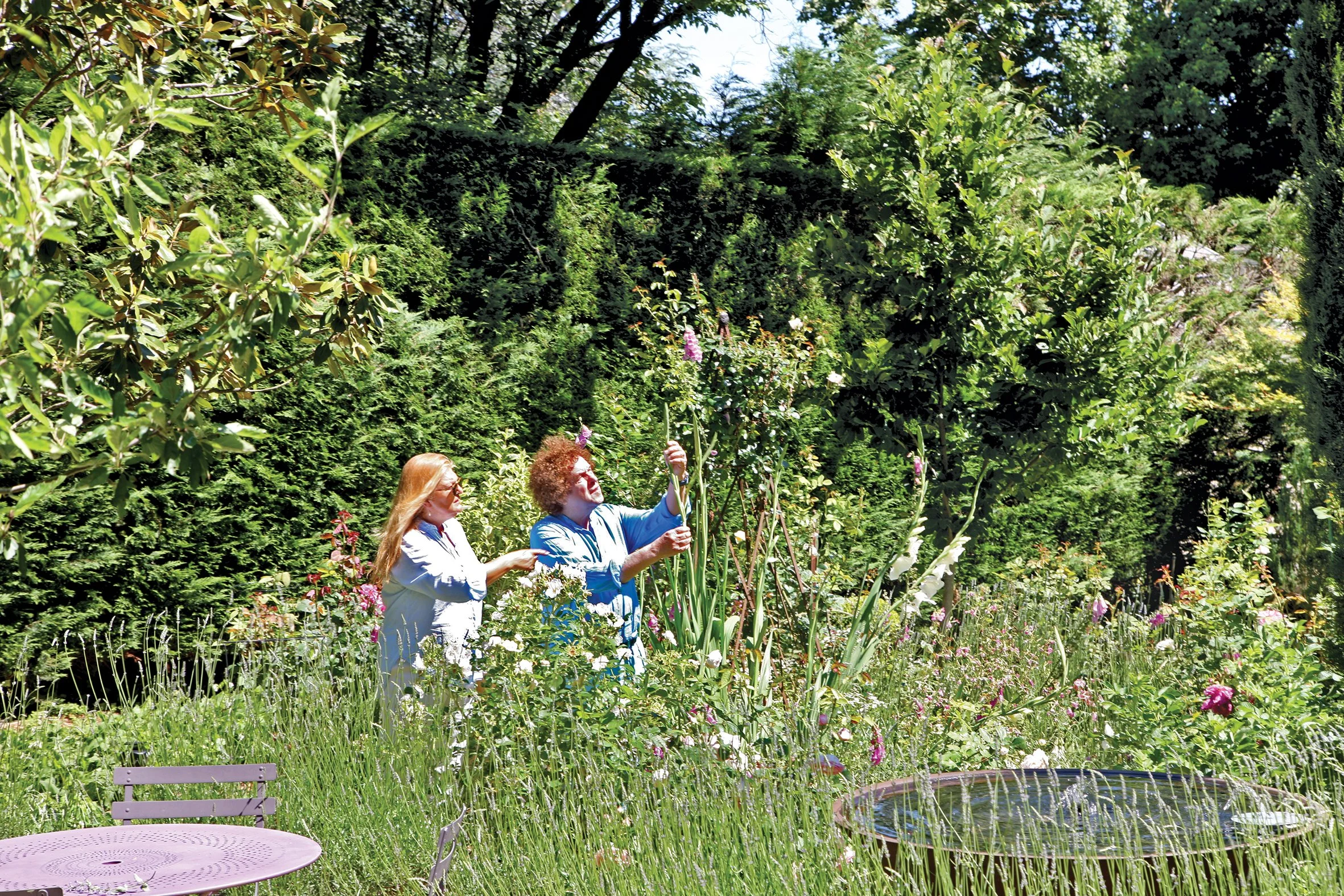
“Before I became a musician, I was a graphic artist,” says Leo, “and I designed some of the David Austin rose labels. I never thought I would be appreciating them here in Australia.
“I often think I should get back in touch and see if they could create a rose named Donatella. It would be so fitting. But whether that happens or not, Donatella has created a garden so full of love. We are so pleased and blessed to be here.”